


Most conversations about sugar and skin focus on diet and breakouts, but did you know that sugar can also accelerate aging? It's a process called glycation, and its primary target is collagen, the protein that gives skin its firmness and elasticity.
When sugar binds to collagen, it makes it stiff, disorganized, and harder to renew. In your skin, this looks like a loss of firmness, reduced elasticity, and a dull complexion. Once you know it exists, there's quite a bit you can do to address it.
We're going to walk you through what glycation is, how it affects your skin, and what you can do to slow it down and support your skin's renewal.
What Is Glycation?
Glycation is a chemical reaction that occurs when excess sugar molecules in the bloodstream attach to proteins or fats. This produces compounds called advanced glycation end products, or AGEs. Your body can't regulate or prevent it from happening. It happens passively, driven by the availability of sugar and accelerated by factors like heat, UV exposure, and oxidative stress.
Collagen is particularly vulnerable. It's the most abundant protein in the dermis, and its long, stable fibers make it an ideal target for sugar attachment. Once AGEs form on collagen, they’re effectively glued together, which disrupts their natural structure and function. Because AGEs accumulate gradually over years, their effects on the skin are easy to miss until they're already well established.
What Glycation Does to Skin
When collagen becomes glycated, the effects show up in ways that are both visible and structural. Research suggests glycation can:
Make collagen fibers stiffer and less supple
Healthy collagen fibers are flexible and responsive. When AGEs bond them together abnormally, they lose that flexibility, and the skin loses its ability to move and recover naturally.
Reduce elasticity
Skin that has lost its elasticity doesn't bounce back the way it used to. Fine lines and sagging become more pronounced as the dermal structure weakens.
Interfere with collagen renewal
The skin continuously turns over and replaces collagen, but glycation disrupts that process, making it harder for fresh, healthy collagen to form.
Disrupt the skin's structural support network
Collagen fibers are organized in a precise way that gives skin its strength and smoothness. The bonds AGEs create throw that organization off, contributing to uneven texture and a loss of firmness.
Contribute to a dull or yellowish skin tone
AGEs have a brown pigment that accumulates in the dermis, which can give skin a sallow, tired appearance.
To sum it up, glycation causes skin to lose its structural integrity: it’s less firm, less elastic, less able to repair itself, and visibly duller.
Prevention: Slowing AGE Formation
Because glycation is driven by sugar availability and oxidative damage, there are clear ways to slow its progression. None of these will stop AGE formation entirely, but they can reduce the rate at which it occurs.
Reduce sugar intake
When blood sugar spikes, glycation accelerates. That's why diets lower in refined carbohydrates and added sugars help reduce the availability of glucose that drives AGE formation (Cosgrove et al., 2007; Danby, 2010).
Limit dietary AGEs
AGEs don't only form inside the body. They're also present in food, particularly anything cooked at high heat through grilling, roasting, or frying. Reducing intake through simple cooking swaps, like steaming, poaching, or marinating before cooking, can lower your overall AGE exposure (Uribarri et al., 2010).
Support antioxidant defenses
Oxidative stress is one of glycation's key accelerants, and antioxidants help neutralize it before it can compound the damage. Vitamins C and E, polyphenols from a plant-rich diet, and topical antioxidant ingredients all contribute to this protective effect (Gkogkolou & Böhm, 2012).
Protect against UV exposure
UV radiation generates oxidative stress in the skin and has been shown to accelerate AGE formation independently of diet. Mineral-based broad-spectrum SPF, combined with physical protection like hats and shade, reduces one of glycation's key environmental drivers (Gkogkolou & Böhm, 2012).
You can't avoid AGEs entirely, but you can meaningfully slow their progression. And when the effects of glycation do show up in your skin, there are targeted ways to help it recover.
Treatment: Supporting Collagen Renewal
Glycation-damaged collagen can't be un-glycated. The bonds AGEs create in collagen fibers are largely irreversible. But the skin is a dynamic organ that continuously turns over collagen and rebuilds its dermal matrix. The goal of treatment is to support and accelerate that renewal process, so fresh, healthy collagen can replace what glycation has compromised.
Topical signal peptides
Signal peptides are designed to support collagen renewal. They work by signaling fibroblasts to produce new collagen, which is exactly what skin needs when glycation has compromised its structural foundation.
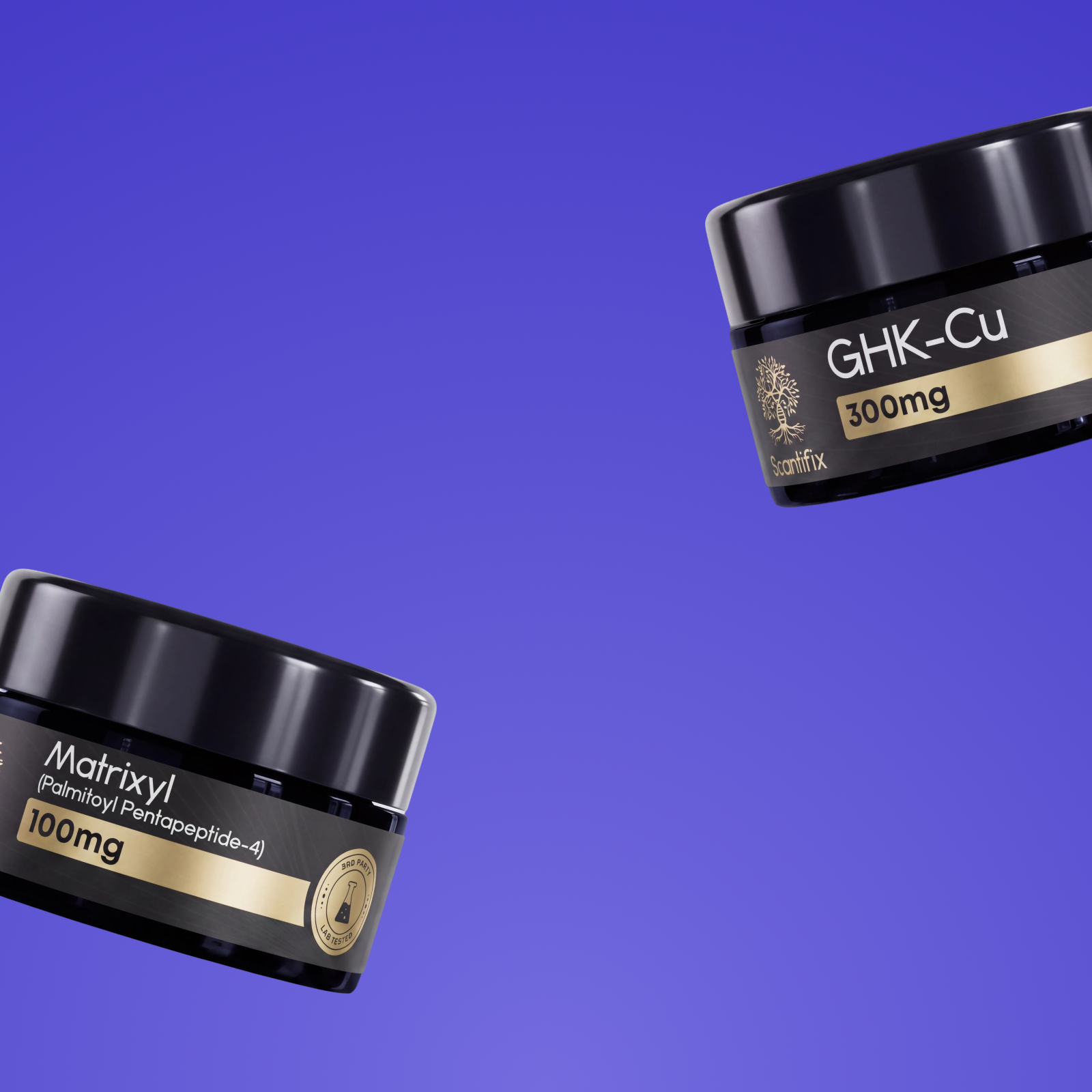
- GHK-Cu is a copper-binding peptide with extensive research supporting its role in collagen and elastin production, tissue remodeling, and the regulation of the enzymes responsible for breaking down and rebuilding the dermal matrix (Pickart & Margolina, 2018).
- Matrixyl (Palmitoyl Pentapeptide-4) mimics collagen fragments to prompt fibroblasts to produce new collagen I and III, the primary structural proteins in the dermis. Research indicates it can improve skin thickness and structural integrity (Schagen, 2017).
- Syn-Coll (Palmitoyl Tripeptide-5) both stimulates new collagen synthesis and inhibits the enzymes that break down existing fibers. The result is more collagen overall, leading to improved skin resilience and firmness (Ferreira et al., 2020).
For a deeper look at how these peptides work together, see our guide to collagen-stimulating signal peptides.
Microneedling
Microneedling uses fine needles to penetrate the dermis, activating the skin's repair response and prompting fibroblasts to produce new collagen and elastin. At depths of 0.5–2.5mm, it encourages organized collagen remodeling and helps rebuild the dermal structure that glycation degrades (Sitohang et al., 2021). It also opens temporary channels in the skin that enhance absorption of topical peptides, making the two approaches especially effective when used together.
Red Light Therapy
At wavelengths of 630–850nm, red light penetrates below the skin's surface and boosts cellular energy production by stimulating mitochondrial activity. That gives fibroblasts more fuel to produce new collagen and support the skin's renewal processes. Research has shown it can increase structural protein levels with consistent use (Wunsch & Matuschka, 2014), and it works particularly well alongside peptides and microneedling.
How Scantifix Can Help
If you’re seeing the effects of glycation or you simply want to start preventative measures, collagen-supporting treatments are the place to start. When you’re choosing products like peptides or at-home devices, the quality matters. Not only does it directly correlate to the level of results you can achieve, but it minimizes the risk of irritation or unwanted side effects.
Our collection of raw, high-purity peptides is independently third-party tested and backed by a Certificate of Analysis, so you know exactly what you're putting on your skin. When it comes to peptides, this is a standard you shouldn’t compromise on. If a company isn’t transparent about the ingredients in their products, they probably don’t have your best interests in mind. Our peptides also come in their raw form with no fillers, buffers or additives. Creating your own DIY serums from raw peptides is simple and gives you full control and flexibility with your formulation. No uncertainty about what’s in your product and you’re free to customize the concentration or stack multiple peptides together.
The same standard applies to our devices. The HydroDerma Pen QS microneedling device and Reviva Lux red light therapy mask are built for safe, professional-level results at home. Both are designed with ease of use in mind, so they fit naturally into your routine. Adjustable settings and advanced features let you tailor each treatment to your skin's needs. And premium, skin-safe materials mean you're not trading convenience for quality. The real value of at-home devices is consistency, and these are built to make that easy.
Key Takeaways
Glycation is one of those things that's been affecting your skin whether you knew about it or not. Now that you do, you're in a much better position to act. Slowing the rate of AGE formation through diet and lifestyle, and supporting your skin's ability to renew itself with the right topical tools and treatments, gives you a real strategy to balance the effects of skin glycation.
At Scantifix, we want you to feel confident and happy in your skin, and we're committed to giving you the quality ingredients and reliable tools to get there.

Resources
Cosgrove, M. C., Franco, O. H., Granger, S. P., Murray, P. G., Mayes, A. E., & Vrijheid, M. (2007). Dietary nutrient intakes and skin-aging appearance among middle-aged American women. The American Journal of Clinical Nutrition, 86(4), 1225–1231. https://doi.org/10.1093/ajcn/86.4.1225
Danby, F. W. (2010). Nutrition and aging skin: Sugar and glycation. Clinics in Dermatology, 28(4), 409–411. https://doi.org/10.1016/j.clindermatol.2010.03.018
Ferreira, M. S., Magalhães, M. C., & Sousa-Lobo, J. M. (2020). Trending anti-aging peptides. Cosmetics, 7(4), 91. https://doi.org/10.3390/cosmetics7040091
Gkogkolou, P., & Böhm, M. (2012). Advanced glycation end products: Key players in skin aging? Dermato-Endocrinology, 4(3), 259–270. https://doi.org/10.4161/derm.22028
Pickart, L., & Margolina, A. (2018). Regenerative and protective actions of the GHK-Cu peptide in the light of the new gene data. BioMed Research International, 2018, 7194543. https://pmc.ncbi.nlm.nih.gov/articles/PMC6073405/
Schagen, S. K. (2017). Topical peptide treatments with effective anti-aging results. Cosmetics, 4(2), 16. https://doi.org/10.3390/cosmetics4020016
Sitohang, I. B. S., Sirait, S. A. P., & Suryanegara, J. (2021). Microneedling in the treatment of atrophic scars: A systematic review of randomised controlled trials. International Wound Journal, 18(5), 577–585. https://doi.org/10.1111/iwj.13559
Uribarri, J., Woodruff, S., Goodman, S., Cai, W., Chen, X., Pyzik, R., Yong, A., Striker, G. E., & Vlassara, H. (2010). Advanced glycation end products in foods and a practical guide to their reduction in the diet. Journal of the American Dietetic Association, 110(6), 911–916. https://doi.org/10.1016/j.jada.2010.03.018
Wunsch, A., & Matuschka, K. (2014). A controlled trial to determine the efficacy of red and near-infrared light treatment in patient satisfaction, reduction of fine lines, wrinkles, skin roughness, and intradermal collagen density increase. Photomedicine and Laser Surgery, 30(2), 93–100. https://doi.org/10.1089/pho.2013.3616


Leave a comment
All comments are moderated before being published.
This site is protected by hCaptcha and the hCaptcha Privacy Policy and Terms of Service apply.