


Collagen starts declining earlier than most people realize. By your mid-20s, production begins to slow. By your 30s and 40s, the effects start becoming visible. You might experience lines deepening, skin losing firmness, and texture changes.
The good news? Your skin still knows how to make collagen. It just needs the right signals.
Signal peptides work with your skin's existing biology to boost its own production of collagen. This guide explains what collagen does, why it declines, and how certain peptides support the process.
What Collagen Does and Why It Declines
Collagen is the structural protein that keeps skin firm. It's the scaffolding beneath the surface that provides support and helps skin bounce back.
Your skin contains different types. Type I makes up about 80% of dermal collagen and provides tensile strength. Type III supports elasticity. Type IV connects the epidermis to the dermis below.
Production peaks in early adulthood and then gradually declines, roughly 1% per year on average. Your fibroblasts (the cells that produce collagen) slow down, becoming less efficient while the enzymes that break down collagen stay active.
UV exposure accelerates breakdown by triggering these degrading enzymes. Environmental stress and inflammation interfere with production. Your skin constantly makes and breaks down collagen, but the balance shifts from production toward breakdown as you age.
Once breakdown begins, all is not lost. It’s possible to support your skin’s natural collagen production.
Signal Peptides: Supporting Your Skin's Own Collagen Production
Signal peptides are short chains of amino acids that act as messengers. They mimic the natural signals your skin uses to tell cells what to do. When applied topically, certain signal peptides can interact with skin cells and help stimulate pathways involved in collagen production. Your skin already has the ability to make collagen. Signal peptides provide the instructions to ramp up production.
Three signal peptides offer different approaches to collagen support.
GHK-Cu
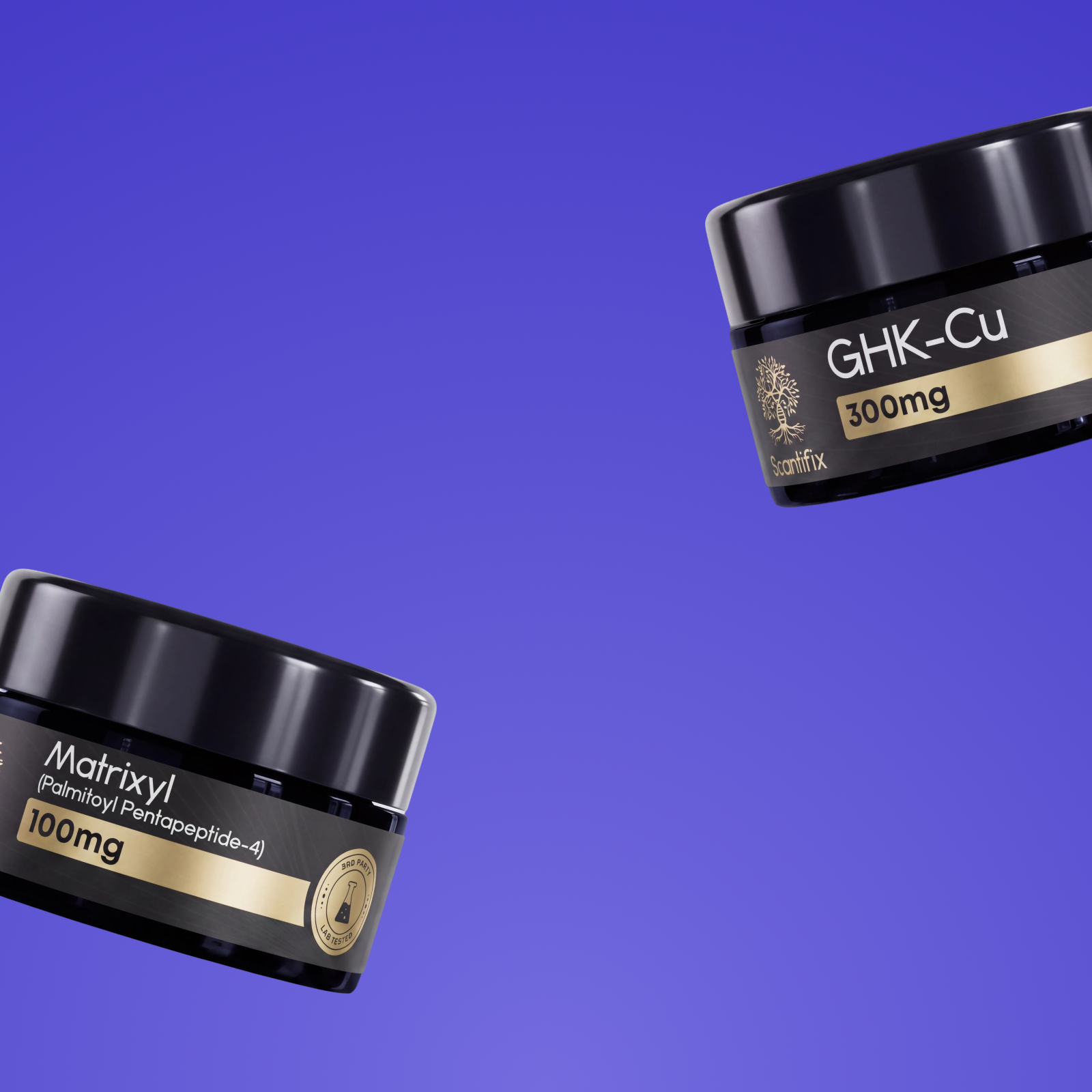
GHK-Cu is a copper-binding peptide that naturally occurs in human plasma, though levels decline with age. Copper plays an essential role in collagen formation because it helps activate an enzyme your skin needs to form strong, stable collagen.
The peptide works by activating fibroblasts and helping them produce more of the structural proteins your skin needs. In a 12-week study, topical GHK-Cu showed improvements in skin structure and collagen markers in a majority of participants (Abdulghani et al., 1998).
Beyond collagen, GHK-Cu appears to support broader regenerative processes, including wound healing and skin repair (Pickart & Margolina, 2018). This makes it valuable not just for collagen support but for overall skin health.
Matrixyl
Matrixyl (Palmitoyl Pentapeptide-4) is a synthetic peptide derived from a fragment of Type I collagen. When fibroblasts detect what appears to be collagen breakdown fragments, they respond by increasing production to replace what seems lost.
Research suggests it can support the production of Types I and III collagen, contributing to improvements in firmness and texture. The attached fatty acid chain helps it penetrate through the skin's outer layers to reach the deeper dermis where fibroblasts work.
One study found that participants using Matrixyl-containing cream showed measurable improvements in skin firmness and reduced fine lines after 12 weeks (Robinson et al., 2005).
Syn-Coll
Syn-Coll (Palmitoyl Tripeptide-5) takes a dual approach. It may support collagen production and help reduce the activity of enzymes involved in collagen breakdown. The peptide mimics a natural protein that signals your skin to increase production of Type I and Type III collagen.
The protective component comes from inhibiting matrix metalloproteinases (MMPs), the enzymes that break down collagen in response to UV exposure and aging. By reducing their activity, Syn-Coll may help preserve existing collagen while new collagen is produced.
This dual mechanism makes it a good option for comprehensive collagen support. It’s often combined with peptides like Matrixyl and GHK-Cu since they operate through different pathways.
Using Collagen-Stimulating Peptides
You'll find collagen peptides in pre-made serums and creams, but raw peptides offer distinct advantages. With raw peptides, you control concentration, freshness, and formulation. There are no fillers, preservatives, or potentially degraded ingredients that have been sitting on a shelf for months. You're working with the peptide in its most potent form.
To use raw peptides, you'll dissolve the peptide into a clean carrier like hyaluronic acid serum to create a topical solution. For detailed guidance on the reconstitution process, see our guide here or watch our reconstitution videos. Once mixed, apply to clean, slightly damp skin and store in the refrigerator to maintain potency.
Because these peptides work through different mechanisms, they can be combined. GHK-Cu, Matrixyl, and Syn-Coll each support collagen differently, so using them together may provide broader support than using just one alone.
The key with any collagen-supporting peptide is consistency. Results build gradually as these peptides support your skin's natural collagen production, with most people seeing improvements over several weeks to months.
What to Look For in Collagen-Stimulating Peptide Products
Not all peptide products are created equally. Purity, formulation, and packaging determine how well these peptides can actually work at the molecular level.
Purity and Testing
Look for peptides that are at least 98% pure with third-party testing. Certificates of Analysis (COAs) should confirm both purity and peptide identity. Lower-purity peptides may contain contaminants that reduce effectiveness or cause irritation.
Clean Formulation
For pre-made formulas, look for short ingredient lists where the peptide is clearly the focus. Avoid unnecessary fillers, fragrances, and alcohols that can compromise peptide stability or irritate skin. Raw peptides eliminate this concern entirely since they contain zero additives.
Transparent Concentrations
Brands should disclose exact peptide concentrations, not hide behind proprietary blends. You need to know what you're actually applying.
Protective Packaging
Light and heat degrade peptides. Look for violet or amber glass containers that block harmful wavelengths and preserve potency.
At Scantifix, we meet each of these standards. Our collagen-supporting peptides are independently tested, filler-free, and held to the highest purity standards. Whether you're working with GHK-Cu, Matrixyl, or Syn-Coll, you're getting peptides verified for purity and quality.
Final Thoughts
Supporting collagen production makes more biological sense than trying to replace what's lost. Your skin has the capacity to make collagen throughout life. It just needs the right signals.
Peptides like GHK-Cu, Matrixyl, and Syn-Coll deliver those signals through different but complementary pathways. They work with your skin's natural processes, and with consistent use, they can help maintain the firmness and structure that naturally decline with age.
References
Abdulghani, A., Sherr, A., Shirin, S., Solodkina, G., Tapia, E., Wolf, B., & Gottlieb, A. B. (1998). Effects of topical creams containing vitamin C, a copper-binding peptide cream and melatonin compared with tretinoin on the ultrastructure of normal skin—A pilot clinical, histologic, and ultrastructural study. Disease Management and Clinical Outcomes, 1(4), 136-141.
Pickart, L., & Margolina, A. (2018). Regenerative and Protective Actions of the GHK-Cu Peptide in the Light of the New Gene Data. International Journal of Molecular Sciences, 19(7), 1987. https://doi.org/10.3390/ijms19071987
Robinson, L. R., Fitzgerald, N. C., Doughty, D. G., Dawes, N. C., Berge, C. A., & Bissett, D. L. (2005). Topical palmitoyl pentapeptide provides improvement in photoaged human facial skin. International Journal of Cosmetic Science, 27(3), 155-160. https://doi.org/10.1111/j.1467-2494.2005.00261.x


Leave a comment
All comments are moderated before being published.
This site is protected by hCaptcha and the hCaptcha Privacy Policy and Terms of Service apply.