


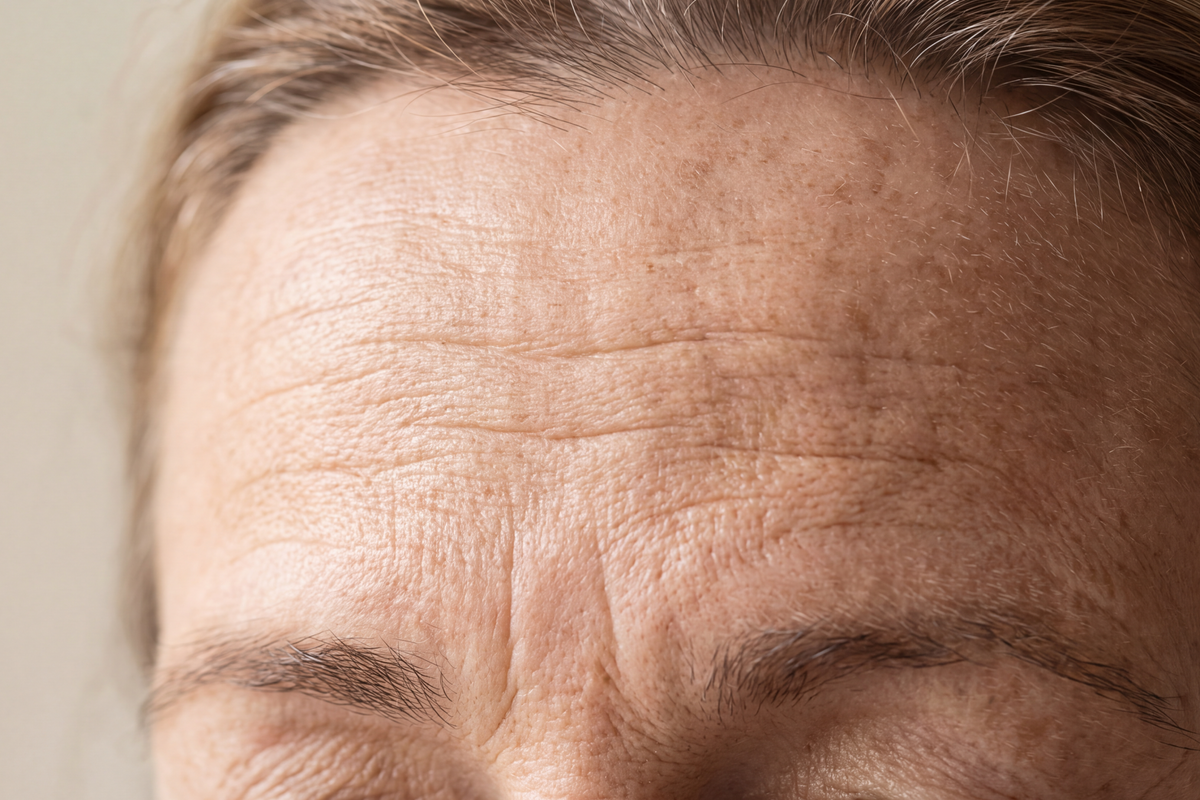
Forehead lines have a habit of becoming increasingly difficult to ignore.
At first, they may appear only when you raise your eyebrows. Over time, some can remain visible even when your face is completely relaxed.
There is a biological reason this area can be particularly difficult to address. And it starts with what happens every time your forehead moves.
Why the Forehead Is Different
The forehead is one of the most expressive areas of the face.
Beneath the skin sits the frontalis, a large facial muscle responsible for raising the eyebrows and creating many of the expressions we make throughout the day. When this muscle contracts, the skin above it folds into horizontal creases.
On younger, resilient skin, those folds generally disappear once the muscle relaxes. But the movement happens again and again, often along very similar crease patterns.
This creates an important distinction between forehead wrinkles and lines caused primarily by changes at the skin's surface. The forehead isn't simply aging. It is aging while being repeatedly folded.
Skin is normally able to tolerate considerable movement because collagen and elastin within the dermis provide strength and flexibility. Over time, however, changes in these structural components make it more difficult for the skin to return completely to its resting position (Fisher et al., 2002).
The result is that temporary expression lines can gradually become more persistent.
When Dynamic Forehead Lines Become Static
Forehead wrinkles often begin as dynamic wrinkles, meaning they appear primarily during facial movement.
Raise your eyebrows and horizontal lines appear. Relax your forehead and they disappear. Eventually, you may notice that they don't disappear quite as completely as they once did.
This is where dynamic and static wrinkles begin to overlap. Static wrinkles remain at least partially visible when the underlying muscles are relaxed. They are influenced not only by repeated movement, but also by changes in collagen, elastin, hydration, sun exposure, and the overall structure of aging skin.
Repeated folding matters because the skin's ability to recover from mechanical stress depends partly on the condition of the dermal extracellular matrix, the network of collagen and other molecules that provides structural support.
As collagen becomes fragmented with age, fibroblasts lose some of the mechanical tension they need to function optimally. This contributes to lower collagen production and further weakening of the surrounding matrix (Varani et al., 2006).
A crease that once disappeared immediately may therefore take longer to smooth out. Eventually, part of it can remain visible at rest.
Why Forehead Lines Can Become More Persistent With Age
Repeated facial movement alone doesn't explain why forehead lines often become more noticeable later in life.
The condition of the skin being folded matters just as much.
Collagen provides much of the dermis with its tensile strength. With age, collagen production decreases while existing collagen becomes increasingly fragmented. Fibroblasts also become less effective at maintaining the extracellular matrix (Fisher et al., 2002; Varani et al., 2006).
Elastin changes as well. Healthy elastic fibers help skin stretch during movement and return toward its original position afterward. Chronological aging and cumulative ultraviolet exposure can alter these fibers, reducing the skin's ability to recover after repeated deformation.
Sun exposure accelerates many of these changes. Ultraviolet radiation contributes to collagen degradation and abnormalities within elastic tissue, making photoaging one of the most important external contributors to visible facial wrinkles (Fisher et al., 2002).
Together, these changes help explain why the same eyebrow movement that left no lasting mark years earlier can eventually contribute to a crease that remains visible throughout the day.
Why Hydration Can Help, But Only So Much
Not every part of a forehead line originates deep within the skin.
Hydration also influences how pronounced fine lines appear at the surface. When the outermost layers of the skin contain adequate water, the surface generally appears smoother and more supple. When skin becomes dry or dehydrated, fine creases can look sharper.
Humectants such as hyaluronic acid attract and retain water, temporarily increasing hydration and creating a plumper-looking skin surface. Moisturizers can also support the skin barrier, helping reduce excessive water loss.
This can make fine forehead lines appear softer.
However, hydration cannot address every factor contributing to a persistent forehead wrinkle. It does not prevent the frontalis muscle from contracting, nor can it independently reverse structural changes such as collagen fragmentation.
For deeper or more established forehead lines, hydration is therefore better understood as one part of a broader approach rather than a complete solution.
Why Different Forehead Lines May Need Different Approaches
People searching for how to get rid of forehead wrinkles are often dealing with several biological processes at the same time.
A line that appears primarily when raising the eyebrows is not identical to a crease that remains deeply visible when the forehead is completely relaxed. Likewise, a fine line made more noticeable by dehydration has different contributing factors than a deeper wrinkle shaped by years of movement and structural change.
That means the appearance of forehead wrinkles may need to be approached from several angles:
- Expression-related movement: Repeated contraction of the frontalis continues folding the skin along familiar patterns.
- Structural changes: Declining collagen, altered elastin, and changes within the extracellular matrix reduce the skin's ability to recover.
- Surface hydration: Dehydrated skin can make existing fine lines appear more pronounced.
- Photoaging: Cumulative UV exposure accelerates structural changes that contribute to wrinkle formation.
Understanding these differences is useful because skincare ingredients also work through different mechanisms. An ingredient that improves hydration is not necessarily addressing expression-related signaling, just as an ingredient associated with collagen support is not directly preventing facial movement.
Where Peptides Fit In
Peptides are particularly interesting for forehead wrinkles because different peptides have been developed to support different parts of the process.
SNAP-8 peptide, also known as Acetyl Octapeptide-3, is commonly used in formulations designed for expression-related wrinkles. Rather than rebuilding collagen, SNAP-8 was developed to influence signaling associated with facial muscle contraction. Its intended cosmetic effect is a gradual softening in the appearance of dynamic lines such as forehead wrinkles and crow's feet.
Argireline, or Acetyl Hexapeptide-8, follows a similar principle. It was designed to resemble part of SNAP-25, a protein involved in neurotransmitter release. Laboratory research suggests Argireline can interfere with neurotransmitter release, while small clinical studies have reported improvements in wrinkle depth following topical application (Blanes-Mira et al., 2002; Wang et al., 2013).
Neither SNAP-8 nor Argireline should be viewed as a topical equivalent to injectable botulinum toxin. Topical peptides do not literally freeze facial muscles, and their effects are generally subtler and more gradual.
Other peptides approach forehead wrinkles from the structural side.
GHK-Cu, a naturally occurring copper-binding peptide, has been extensively investigated for its involvement in tissue remodeling, wound repair, extracellular matrix organization, and collagen-related processes (Pickart & Margolina, 2018).
Matrixyl peptides have similarly been investigated for collagen-related signaling. Research on palmitoyl pentapeptide formulations has reported improvements in photoaged facial skin following consistent topical use (Robinson et al., 2005).
This distinction is important. A peptide designed to influence expression-related signaling and one designed to support collagen-related processes aren't necessarily addressing the same component of a forehead wrinkle.
Multi-peptide formulas such as Agelixir take a broader approach by combining peptides that target different aspects of visible skin aging. Rather than treating every wrinkle as though it has a single cause, this approach recognizes that expression-related movement, structural changes, hydration, and overall skin quality can overlap within the same area.
Why Consistency Matters With Forehead Lines
Forehead wrinkles develop gradually, and changes in their appearance generally happen gradually as well.
Collagen remodeling, improvements in hydration, and the cosmetic effects associated with topical peptides all require time. This is one reason clinical studies evaluating peptide skincare commonly assess results after several weeks or months rather than a few applications.
Meanwhile, the forehead continues moving every day.
This doesn't mean facial expressions should be avoided. They are a normal part of human communication. It simply helps explain why persistent forehead lines are unlikely to change dramatically after a few days of skincare.
A consistent routine provides ongoing support while the skin continues its normal processes of renewal and remodeling.
Final Thoughts
Forehead lines are a good example of why wrinkles cannot always be treated as a single skin concern.
Repeated facial movement may create the original crease, but collagen loss, changes in elasticity, hydration, photoaging, and the skin's declining ability to recover from mechanical stress can all influence whether that crease eventually becomes permanent.
That also explains why there is no single topical ingredient that addresses every aspect of a forehead wrinkle.
Understanding what's behind the line makes it easier to set realistic expectations and choose skincare that supports the biological processes involved. Forehead wrinkles may be persistent, but knowing why they form is the first step toward approaching them more thoughtfully.
REFERENCES
Blanes-Mira, C., et al. (2002). A Synthetic Hexapeptide (Argireline) With Antiwrinkle Activity. International Journal of Cosmetic Science, 24(5), 303–310. https://doi.org/10.1046/j.1467-2494.2002.00153.x
Fisher, G. J., et al. (2002). Mechanisms of Photoaging and Chronological Skin Aging. Archives of Dermatology, 138(11), 1462–1470.
https://doi.org/10.1001/archderm.138.11.1462?
Pickart, L., & Margolina, A. (2018). Regenerative and Protective Actions of the GHK-Cu Peptide in the Light of the New Gene Data. International Journal of Molecular Sciences, 19(7), 1987.
https://www.mdpi.com/1422-0067/19/7/1987
Robinson, L. R., et al. (2005). Topical Palmitoyl Pentapeptide Provides Improvement in Photoaged Human Facial Skin. International Journal of Cosmetic Science, 27(3), 155–160.
https://onlinelibrary.wiley.com/doi/10.1111/j.1467-2494.2005.00261.x
Varani, J., et al. (2006). Decreased Collagen Production in Chronologically Aged Skin: Roles of Age-Dependent Alteration in Fibroblast Function and Defective Mechanical Stimulation. The American Journal of Pathology, 168(6), 1861–1868.
https://ajp.amjpathol.org/article/S0002-9440(10)62205-5/fulltext
Wang, Y., et al. (2013). The Anti-Wrinkle Efficacy of Argireline, a Synthetic Hexapeptide, in Chinese Subjects: A Randomized, Placebo-Controlled Study. American Journal of Clinical Dermatology, 14(2), 147–153. https://link.springer.com/article/10.1007/s40257-013-0009-9


Leave a comment
All comments are moderated before being published.
This site is protected by hCaptcha and the hCaptcha Privacy Policy and Terms of Service apply.