


Copper peptides have earned a pretty long list of skincare rules.
Don't use them with vitamin C. Don't use them with retinol. Don't use them with acids. Don't use them with this, that, or the other thing.
But how much of that advice is actually based on chemistry, and how much is just skincare folklore?
The answer is a little more nuanced.
Copper peptides can be combined with many common skincare ingredients. The bigger concern is formulation compatibility, particularly when you're working with a raw copper peptide rather than a professionally formulated finished product.
Here's what you actually need to know.
Copper Peptides
Copper peptides are small peptides that bind copper ions. GHK-Cu, or copper tripeptide-1, is one of the best-known examples and has been studied extensively in relation to skin biology, tissue remodeling, and extracellular matrix processes (Pickart & Margolina, 2018).
More recently, other copper peptides such as AHK-Cu have attracted interest for different applications, including hair and scalp research.
The important thing is that copper isn't simply an extra ingredient attached to the peptide. The copper-peptide complex has its own chemical properties, which means the surrounding formulation can matter.
That is where ingredient compatibility comes in.
Why Does It Matter What You Mix With Copper Peptides
When you're using a finished copper peptide serum, the manufacturer has already taken factors such as pH, concentration, stability, preservation, and ingredient compatibility into account.
A raw peptide is different.
If you're reconstituting copper peptide powder yourself, you're effectively creating your own formulation. The carrier, pH, other actives, and storage conditions can all influence the resulting mixture.
Research on GHK-Cu has found that the peptide is susceptible to degradation under oxidative and basic conditions, although it showed relatively good stability in water and several buffers between pH 4.5 and 7.4 under the specific conditions tested (Badenhorst et al., 2016).
So the question isn't simply: "Can these two ingredients touch?" It's: "Are these ingredients chemically and cosmetically compatible in this particular formulation?"
That distinction makes a big difference.
Copper Peptides and Vitamin C
This is probably the most famous copper peptide combination to avoid.
The concern is primarily with pure L-ascorbic acid, the acidic form of vitamin C commonly used in low-pH serums.
L-ascorbic acid is a reducing agent, while copper can participate in oxidation-reduction reactions (Shen et al., 2021; Song et al., 2007). When the two are placed together under certain formulation conditions, the chemistry can interfere with the stability of both ingredients.
There's also a pH issue. Pure L-ascorbic acid is generally formulated at a much lower pH than the mildly acidic-to-neutral conditions commonly used for copper peptide formulations (Pinnell et al., 2001). That makes putting the two into the same DIY mixture particularly unattractive from a formulation standpoint.
This doesn't mean you have to choose between vitamin C and copper peptides.
A simple solution is to use them at different times. For example:
Morning: Vitamin C
Evening: Copper peptide
You can also use different vitamin C derivatives, which may have different formulation requirements. But compatibility should be assessed based on the specific derivative and finished formula rather than assuming that every form of vitamin C behaves the same way.
What About Retinol
Retinol is a little different.
There isn't a simple rule that copper peptides and retinoids can never be used together. In fact, both can have a place in the same broader skincare routine.
The bigger issue is formulation stability and skin tolerance.
Retinoids are sensitive to oxidation, while copper chemistry can contribute to oxidation under some conditions. This makes the exact formulation important, particularly when you're mixing ingredients yourself rather than using professionally formulated products (Rakuša et al., 2021).
There's also a practical consideration: retinoids can be irritating, especially when you're introducing them to a routine. Adding several active ingredients at the same time makes it harder to tell which product is responsible if your skin becomes dry or irritated.
So rather than mixing copper peptide powder directly into a retinoid serum, keep the products separate. Or, if your routine already contains both and your skin tolerates them, follow the instructions provided for the finished products.
Copper Peptides and Exfoliating Acids
This is another pairing where formulation pH matters.
AHAs such as glycolic and lactic acid, as well as BHA products containing salicylic acid, are designed to create an acidic environment on the skin.
That doesn't automatically make them incompatible with every copper peptide product, but combining a raw copper peptide with a strongly acidic formula is a different story.
The chemistry of GHK-Cu can change depending on the surrounding environment, and studies have found that the peptide is more vulnerable under certain acidic, basic, and oxidative conditions. Importantly, the published data do not support the simplistic idea that GHK-Cu instantly becomes unstable whenever it encounters anything below neutral pH (Badenhorst et al., 2016).
For DIY formulations, the safer approach is therefore to avoid combining raw copper peptide powder directly with strong acid products.
If you use both in your routine, separate them.
This also has a practical benefit: you're less likely to overload your skin with multiple potentially irritating actives at once.
What About Benzoyl Peroxide
Benzoyl peroxide is a strong oxidizing ingredient, which makes it a less obvious partner for a copper-containing peptide.
Because copper-peptide stability can be affected by oxidative conditions, I wouldn't recommend adding benzoyl peroxide directly to a DIY copper peptide formulation.
If both products have a place in your routine, keeping them separate is the more sensible approach.
Can You Use Copper Peptides With Niacinamide
Yes.
There is no strong reason to treat niacinamide as a universal ingredient to avoid when using copper peptides.
Niacinamide is commonly used in skincare for barrier support, hydration, and overall skin appearance, while copper peptides are included for their own biological signaling and tissue-remodeling properties.
The two ingredients have different roles, so they can fit into the same broader routine.
As always, the finished formulation matters. A product containing copper peptides and niacinamide should be properly formulated and tested rather than created by randomly combining concentrated raw ingredients.
What About Zinc
You may hear that zinc and copper shouldn't be mixed because the two minerals can compete with each other. That's a real consideration when we're talking about mineral absorption in the body, but it doesn't automatically mean that a zinc skincare ingredient will deactivate a topical copper peptide.
The more relevant question for a DIY serum is what kind of zinc you're using and what happens inside the formula.
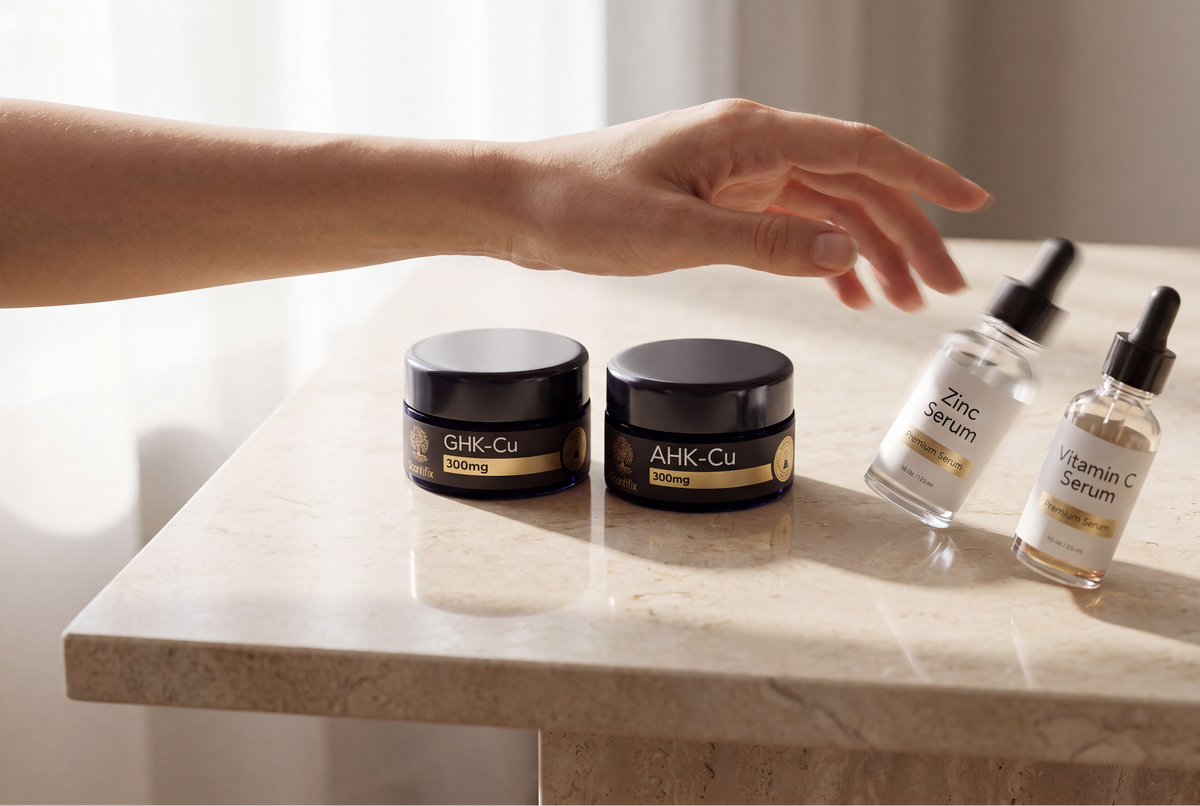
AHK-Cu, for example, already contains copper coordinated to a specific peptide sequence. Adding a zinc introduces another metal-containing ingredient into the same solution. Depending on the zinc compound, concentration, pH, and other ingredients present, this can make the formulation chemistry more difficult to predict.
Mixing with Hyaluronic Acid
This is one of the simpler combinations.
Hyaluronic acid and copper peptides can complement each other nicely in a topical routine.
Hyaluronic acid is a humectant that helps attract and retain water, while copper peptides are included for their biological activity.
This is also why a water-based hyaluronic acid serum can make a practical carrier for certain DIY peptide formulations.
For example, ScantiHA is designed as a water-based peptide serum base and can be used as a convenient carrier for compatible topical peptide formulations.
Can You Mix Copper Peptides With Other Peptides
Generally, copper peptides don't need to be kept completely separate from every other peptide.
But there's an important distinction between combining peptides and proving that they work better together.
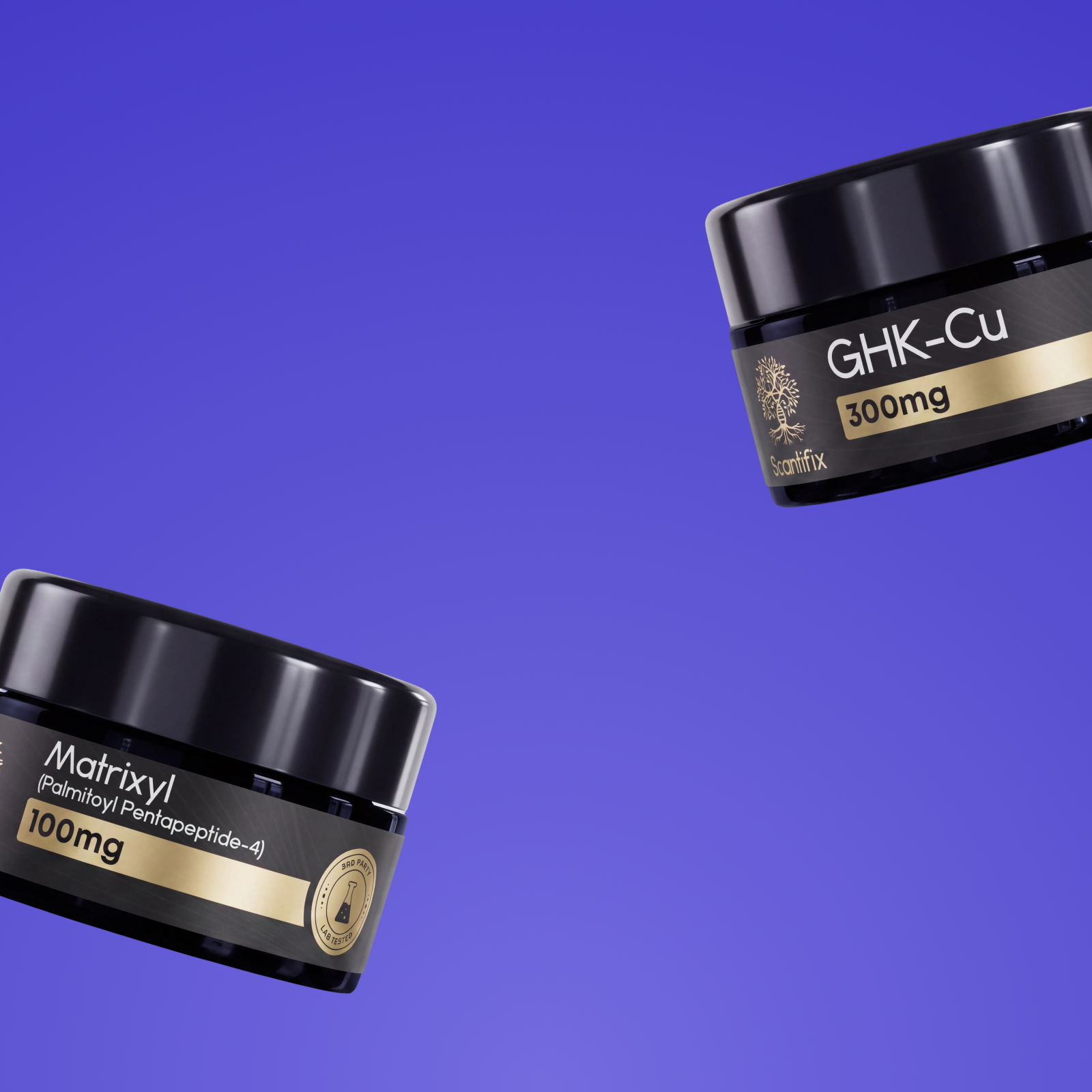
Putting GHK-Cu, AHK-Cu, Matrixyl, or another peptide into the same formula doesn't automatically create synergy.
Each peptide has its own structure, concentration, stability requirements, and biological targets.
This is particularly relevant when working with raw peptide powders. Combining several ingredients yourself can make the final concentration, pH, stability, and preservation much harder to control.
More peptides aren't automatically better.
A well-formulated formula with a thoughtful combination of ingredients can make much more sense than simply adding everything to the same bottle.
A Simple Copper Peptide Routine
If you want to keep things straightforward, you don't need ten active ingredients.
Morning
Cleanser
Vitamin C, if desired
Hydrating serum
Moisturizer
Sunscreen
Evening
Cleanser
Copper peptide serum
Hydrating or barrier-supporting products
Moisturizer
If you're also using a retinoid or exfoliating acid, consider placing it in a separate routine rather than combining everything at once.
This approach also makes it easier to understand how your skin responds to each active.
Final Thoughts
Copper peptides aren't fragile ingredients that need to live alone.
But they're also not something you should throw into every serum in your bathroom and hope for the best.
The biggest considerations are pH, oxidation, formulation stability, and the specific ingredients you're combining. Research on GHK-Cu shows that its stability depends on the surrounding chemical environment, which is one reason formulation matters so much.
For finished products, the formulation should already account for these factors.
For raw copper peptides, it's up to you to think about them.
So instead of asking whether copper peptides can be mixed with everything, a better question is if the combination makes sense chemically, cosmetically, and for your routine.
References
Badenhorst, T., et al. (2016). Physicochemical characterization of native glycyl-l-histidyl-l-lysine tripeptide for wound healing and anti-aging: a preformulation study for dermal delivery. Pharmaceutical Development and Technology, 21(2), 152–160. https://pubmed.ncbi.nlm.nih.gov/25384620/
Pinnell, S. R., et al. (2001). Topical L-ascorbic acid: percutaneous absorption studies. Dermatologic Surgery. https://pubmed.ncbi.nlm.nih.gov/11207686/
Rakuša, Ž., et al. (2021). Retinoid stability and degradation kinetics in commercial cosmetic products. Journal of Cosmetic Dermatology, 20(7), 2350–2358. https://pubmed.ncbi.nlm.nih.gov/33206444/
Shen, et al. (2021). Ascorbate oxidation by iron, copper and reactive oxygen species: review, model development, and derivation of key rate constants. Scientific Reports, 11, 7417. https://doi.org/10.1038/s41598-021-86477-8
Song, et al. (2007). Measurement and characterization of singlet oxygen production in copper ion-catalyzed aerobic oxidation of ascorbic acid. Talanta, 72(1), 231–236. https://pubmed.ncbi.nlm.nih.gov/19071607/


Leave a comment
All comments are moderated before being published.
This site is protected by hCaptcha and the hCaptcha Privacy Policy and Terms of Service apply.