


Summer is great for a lot of things.
Microneedling? Not necessarily one of them.
Between stronger sun exposure, hot weather, sweating, swimming, and packed calendars, summer isn't always the easiest season to start a treatment that works best with a little consistency and patience.
Fall is different.
Cooler temperatures, less intense sun exposure, and a return to regular routines can make this season a particularly convenient time to start a microneedling routine.
Here's why.
What Does Microneedling Actually Do
Microneedling uses tiny needles to create controlled micro-injuries in the skin. This triggers the skin's natural wound-healing response, including signaling involved in collagen production and tissue remodeling (Hou et al., 2017; Alster & Graham, 2018).
The idea isn't to damage the skin for the sake of it.
It's to give the skin a controlled stimulus that encourages it to begin repairing and rebuilding.
Over time, this can help improve the appearance of skin texture, fine lines, scarring, and other signs of photoaging. Recent reviews continue to find microneedling useful for facial rejuvenation, although treatment protocols and outcomes vary between studies (Foppiani et al., 2025).
Why Fall Is a Good Time to Start
This is where the season actually matters.
Less Intense Sun Exposure
After microneedling, your skin needs a little extra care, particularly when it comes to UV exposure.
Fall doesn't eliminate UV exposure, and sunscreen is still essential. But shorter days and generally lower UV intensity can make it easier to manage sun exposure compared with the height of summer.
That's useful when you're starting a routine that involves repeated treatments.
Cooler Weather
Heat and sweating aren't exactly the most comfortable combination with freshly treated skin.
Cooler weather can make it easier to keep your skin comfortable while it settles after treatment. It also means fewer days spent sweating through your skincare routine or jumping straight from a treatment into outdoor activities.
A Little More Routine
Summer tends to be unpredictable. Travel. Weekends away. Long days outside. Late nights.
Fall has a way of putting everyone back on a schedule.
And that's useful because microneedling isn't really about one impressive session. The effects develop gradually, and studies evaluating facial rejuvenation commonly use multiple treatment sessions over time (Foppiani et al., 2025).
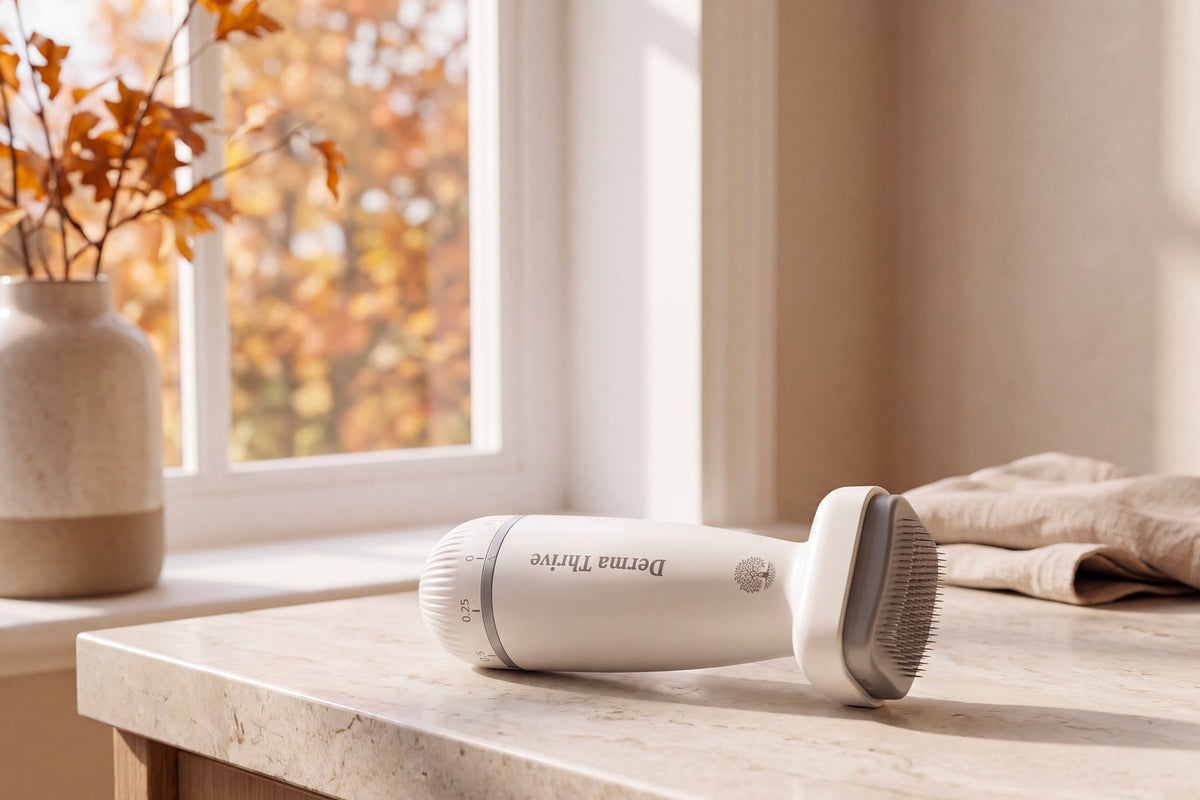
Meet Derma Thrive
If you've been thinking about bringing microneedling into your skincare routine, Derma Thrive makes it possible to do it at home.
The device is designed around controlled microneedling, giving you a way to incorporate mechanical stimulation into a regular skincare routine rather than relying on occasional professional treatments.
The goal isn't to replicate a clinical procedure at home, but to make consistent, controlled skincare more accessible.
And because microneedling works through a gradual remodeling process, consistency matters more than chasing the most aggressive treatment possible.
What Can You Expect From Microneedling
Microneedling isn't the kind of treatment where you necessarily wake up the next morning with completely different skin.
That's part of the appeal.
The skin's response develops over time as repair and remodeling processes continue.
After Your First Sessions
Your skin may feel smoother and look fresher as it recovers. Temporary redness, dryness, or sensitivity can occur after microneedling and generally resolve relatively quickly (Alster & Graham, 2018; Hou et al., 2017).
With Consistent Use
As treatments accumulate, improvements in skin texture and the appearance of fine lines or uneven areas may become more noticeable (Foppiani et al., 2025).
Clinical studies have also reported changes in skin architecture, including collagen- and elastin-related changes, following repeated microneedling treatments.
Over Time
Collagen remodeling doesn't happen overnight (El-Domyati et al., 2015).
That's why microneedling is better thought of as a process rather than a one-time treatment. The goal is to give the skin repeated, controlled signals and allow its own repair processes to do the rest.
Microneedling Doesn't Replace Your Skincare Routine
Think of microneedling as another part of the routine, not the entire routine.
After treatment, keeping things simple is usually the smarter approach. Focus on hydration, barrier support, and sun protection rather than immediately piling on every active in your bathroom.
This is also where ingredients such as hyaluronic acid can make sense.
A hydrating serum such as ScantiHA can help support comfortable, well-hydrated skin while you continue with your normal routine.
The important thing is to follow the instructions for your specific device and avoid using products that aren't appropriate for application to recently treated skin.
What Should You Avoid Around Microneedling
More isn't always better.
Around a microneedling session, be cautious with products that can increase irritation, including strong exfoliating acids and retinoids. You also don't want to treat freshly microneedled skin as though nothing happened and immediately return to an aggressive active-heavy routine (International Expert Consensus, 2026).
And don't forget sunscreen. UV exposure is one of the major contributors to photoaging, so protecting your skin remains important before and after microneedling, regardless of the season.
Microneedling also isn't appropriate for every skin situation. Active infections and certain inflammatory or dermatological conditions can increase the risk of complications, so it's important to follow appropriate safety guidance and device instructions (Chu et al., 2021).
Final Thoughts
Microneedling works with the skin's natural repair processes, and those processes take time.
That's why the best approach isn't necessarily the most aggressive one. It's the one you can use consistently, safely, and with realistic expectations.
Fall simply gives you a few practical advantages: cooler weather, less intense sun exposure, and a natural return to routine.
And sometimes, that's all the reason you need to finally start.
References
Alster, T. S., & Graham, P. M. (2018). Microneedling: A Review and Practical Guide. Dermatologic Surgery, 44(3), 397–404. https://pubmed.ncbi.nlm.nih.gov/28796657/
Chu, S., et al. (2021). Safety Profile for Microneedling: A Systematic Review. Dermatologic Surgery, 47(9), 1249–1254. https://pubmed.ncbi.nlm.nih.gov/34448760/
El-Domyati, M., et al. (2015). Multiple microneedling sessions for minimally invasive facial rejuvenation: an objective assessment. International Journal of Dermatology, 54(12), 1362–1369. https://pubmed.ncbi.nlm.nih.gov/26096653/
Foppiani, J. A., et al. (2025). Microneedling for Facial Rejuvenation: A Systematic Review. Aesthetic Plastic Surgery, 49, 4949–4960. https://pubmed.ncbi.nlm.nih.gov/40542236/
Hou, A., et al. (2017). Microneedling: A Comprehensive Review. Dermatologic Surgery, 43(3), 321–339. https://pubmed.ncbi.nlm.nih.gov/27755171/
2026 International Expert Consensus. International Expert Consensus on Integrated Skincare Active Ingredients for Pretreatment and Posttreatment Use With Medical Aesthetic Procedures to Enhance Skin Benefits. https://pubmed.ncbi.nlm.nih.gov/42087526/

Leave a comment
All comments are moderated before being published.
This site is protected by hCaptcha and the hCaptcha Privacy Policy and Terms of Service apply.