


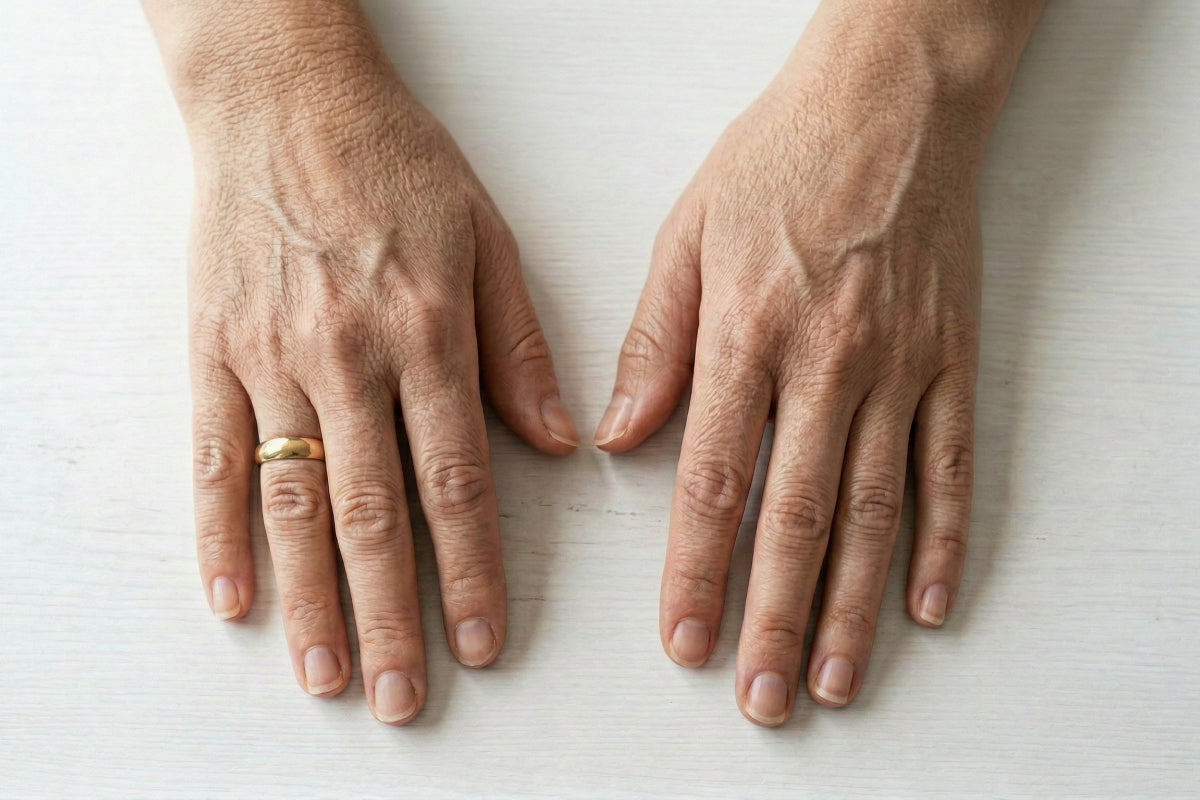
Crepey skin is one of the more common signs of skin aging. Skin looks thinner, feels looser, and has a finely crinkled texture. Unlike surface dryness or expression lines, it reflects a deeper structural shift in the skin itself.
Whether you are looking to get ahead of it early or exploring treatment options now, understanding what crepey skin is, what causes it, and what science-backed solutions exist makes it much easier to take meaningful action.
What Is Crepey Skin?
Crepey skin gets its name from the paper it resembles: thin, soft, and loosely textured, like crepe paper. It tends to appear in areas where the skin is naturally thinner, lower in subcutaneous fat, subject to frequent movement, or regularly exposed to UV. Common areas include under the eyes, the inner arms, the neck, the décolletage, the knees, and the hands. In these areas, skin may look slightly gathered or droopy, with a fine, diffuse crinkle that feels different from a typical wrinkle.
What is happening underneath is a thinning of the dermis, the deeper layer of skin responsible for volume and resilience. Collagen and elastin, the proteins that give skin its firmness and snap, have broken down or depleted. The skin loses its ability to spring back into shape. The dermal-epidermal junction (DEJ), which anchors the skin's layers together, also weakens with age, further contributing to that loose, paper-like quality.
It is worth distinguishing crepey skin from a few related concerns:
-
- Dry skin is primarily a surface moisture issue. It can make crepey texture more visible, but hydrating the skin alone will not address the underlying structural loss.
- Wrinkles are typically caused by repeated muscle movement folding the skin over time, and tend to be more localized, around the eyes, forehead, or mouth.
- Crepey skin is more diffuse and reflects a loss of structural integrity across an area rather than a crease in a specific location. It can overlap with both dryness and wrinkles, but it is its own distinct phenomenon and responds best to its own approach.
What Causes Crepey Skin?
Crepey skin develops from a combination of intrinsic aging and external factors that accelerate structural breakdown. Some of these factors are unavoidable, but several can be meaningfully slowed.
Natural aging
Fibroblasts, the cells responsible for producing collagen and elastin, slow down with age. As collagen and elastin levels decline, the skin becomes thinner and less resilient. The dermal-epidermal junction (DEJ) also weakens over time, reducing the structural cohesion between skin layers.
UV exposure
Photoaging is one of the most significant drivers of crepey skin. UV radiation directly degrades existing collagen and elastin while impairing the skin's ability to synthesize new structural proteins. Cumulative sun exposure over years is a primary reason some people experience significant laxity (looseness and loss of firmness) earlier than others.
Hormonal changes
Declining estrogen, particularly around and after menopause, has a direct impact on collagen density. Research suggests the skin loses a notable portion of its collagen in the years following menopause, which contributes to the rapid onset of laxity many women experience during this time.
Weight fluctuations
Significant changes in body weight place repeated stress on the skin's elastic fibers. Over time, this can reduce the skin's ability to spring back, particularly in areas like the arms and abdomen.
Lifestyle factors
Smoking impairs circulation and accelerates collagen degradation. Poor nutrition deprives the skin of the building blocks needed for structural repair. Chronic dehydration and insufficient sleep also reduce the skin's capacity to maintain and renew itself.
Prevention: Starting Early Makes a Difference
When it comes to crepey skin, prevention genuinely outperforms treatment. The structural changes involved develop gradually over years, and slowing that process early produces far better outcomes than trying to reverse it later. No treatment, however effective, can fully replicate what healthy, well-supported skin maintains on its own.
These habits are worth building sooner rather than later:
-
- Wear broad-spectrum SPF daily. Sun protection is the single most evidence-backed step you can take. UV exposure degrades collagen and elastin and accelerates the structural thinning that leads to crepey skin. Daily SPF use, even on cloudy days, meaningfully slows this process over time.
- Eat to support collagen synthesis. The skin relies on specific nutrients to produce and maintain collagen. Vitamin C is essential for collagen cross-linking and acts as an antioxidant against UV-related damage. Adequate protein provides the amino acids collagen is built from. Zinc supports cellular repair and wound healing processes in the skin.
- Stay hydrated. Dehydration reduces skin plumpness and makes structural thinning more visible. While water intake alone will not prevent crepey skin, chronically dehydrated skin has a reduced capacity to maintain its barrier and appearance over time.
- Avoid smoking. Smoking constricts blood vessels, reducing oxygen and nutrient delivery to the skin. It also directly increases the activity of enzymes that break down collagen, accelerating the structural decline that underlies crepey skin.
- Prioritize sleep. The skin undergoes much of its repair and renewal during sleep, driven by growth hormone release and reduced cortisol levels. Chronic sleep deprivation impairs these processes and has been linked to accelerated skin aging.
- Build a consistent skincare routine. Starting active topical support early, before crepey skin becomes established, is one of the most practical preventive steps available. Peptides that signal collagen and elastin production, microneedling to stimulate cellular renewal, and red light therapy to support fibroblast activity are all worth incorporating as long-term habits. The earlier these become part of your routine, the more structural integrity you carry forward.
Scientifically Backed Solutions for Crepey Skin
If you are looking for ways to get rid of crepey skin, meaningful improvement is possible, though it requires consistency and usually a combination of approaches. Because crepey skin reflects structural loss at the dermal level, the most effective treatments are those that address collagen and elastin production, skin renewal, or both. Here is what the evidence supports.
Topical Signal Peptides
Signal peptides are short chains of amino acids that communicate with skin cells, prompting them to produce structural proteins like collagen and elastin. More people are exploring topical peptides because they work with the skin’s own signaling biology, are non-invasive, and are generally well tolerated by most skin types.
-
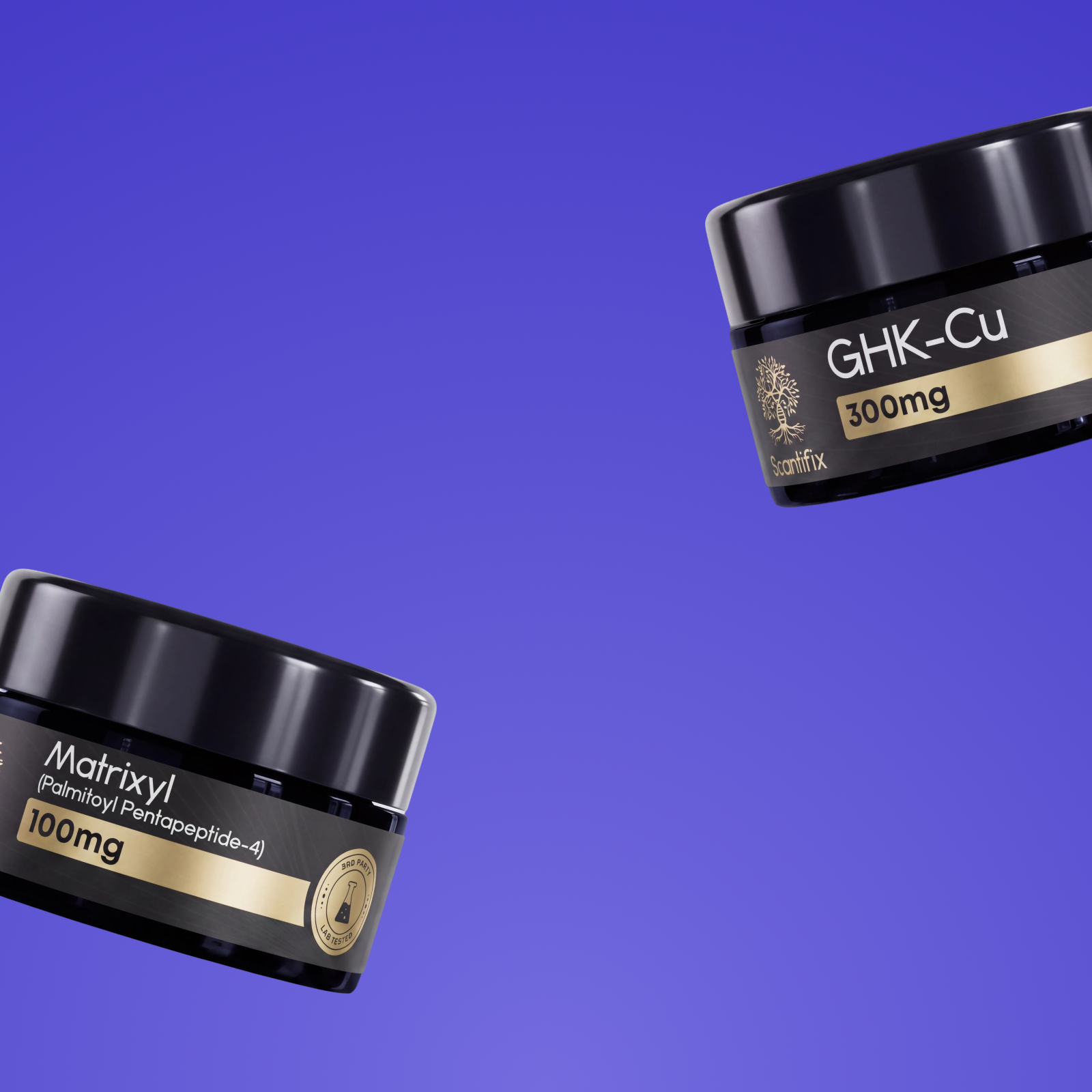
- GHK-Cu (Copper Tripeptide-1) is among the most studied for this purpose, with research indicating it can stimulate collagen I and III synthesis, increase elastin production, modulate the enzymes that break down structural proteins, and activate wound repair pathways in the skin (Pickart & Margolina, 2018).
- Matrixyl (Palmitoyl Pentapeptide-4) signals fibroblasts to increase collagen production and has demonstrated improvements in skin thickness with consistent use (Robinson et al., 2005).
- Syn-Tacks targets the DEJ, stimulating the structural proteins that anchor the skin's layers together, which is the same junction that weakens as crepey skin develops.
When choosing peptides, purity and transparency matter. Look for products that are third-party tested, with Certificates of Analysis confirming purity and identity. Avoid unnecessary additives that can compromise stability or irritate the skin. Raw peptides offer the most control over concentration and formulation and are easy to reconstitute into effective DIY serums.
Microneedling
Microneedling creates controlled micro-injuries in the skin that activate its natural repair response, stimulating collagen and elastin production in the process. In clinical studies, microneedling has been shown to significantly increase dermal collagen levels in the months following treatment, with some research reporting up to a four-fold increase in collagen formation (Aust et al., 2008). It also creates temporary microchannels that enhance the absorption of topical ingredients, making it especially effective when paired with collagen-supporting actives like peptides.
When choosing an at-home microneedling device, look for safe and hygienic cartridges and an easy-to-use design that makes consistent use realistic. Adjustable needle depth is also beneficial, as different depths work better for different areas. For example, nanoneedling at shallower depths is gentler on delicate areas like under the eyes and the neck, which are common locations for crepey skin.
Red Light Therapy
Red and near-infrared light penetrates below the skin’s surface, where it is absorbed by mitochondria inside cells. This process increases cellular energy production in the form of ATP, which helps stimulate fibroblasts to produce collagen and elastin.
Clinical studies have shown that red and near-infrared light therapy can increase collagen production and improve skin elasticity over time, supporting the structural renewal crepey skin requires. It is also non-invasive, with a strong safety profile across skin types. (Lee et al., 2007; Avci et al., 2013).
When considering a red light therapy mask, prioritize dual-wavelength coverage spanning both red and near-infrared light, a high LED count for even distribution, and hypoallergenic, skin-safe materials. Red light therapy delivers its benefits cumulatively, so a design that fits naturally into your routine for ease-of-use is important.
Topical Retinoids
Retinoids are vitamin A derivatives with well-established evidence for stimulating collagen synthesis and accelerating cell turnover in photoaged skin (Griffiths et al., 1993). Tretinoin, the prescription-strength form, has the strongest evidence base but requires a prescription and carries a higher risk of irritation. Retinol is the accessible over-the-counter alternative that works through the same pathway but converts more slowly in the skin, producing a gentler effect. Starting with retinol is a sensible first step for most people, though consulting a dermatologist is advisable before incorporating any retinoid into your routine, particularly if you have existing skin concerns.
Professional Treatments
For those looking to take a more clinical route, several in-office treatments have demonstrated improvements in skin laxity and collagen density. Options include fractional laser resurfacing, radiofrequency-based tightening, and medium-depth chemical peels. All three are best discussed with a qualified dermatologist to determine the right option based on your skin's specific needs.
The Bottom Line: Building a Stronger Foundation
Crepey skin is a reflection of what happens beneath the surface when collagen, elastin, and the connective architecture of the skin thin and weaken over time. That process is gradual, which means both prevention and treatment require a long-term, consistent approach to see meaningful results.
No single intervention works in isolation. The most meaningful improvements tend to come from combining approaches: daily habits that protect and support the skin's foundation, topical treatments that signal structural renewal, and devices or clinical interventions that stimulate deeper repair. The earlier you begin supporting collagen and elastin production, the better positioned you are to maintain your skin's structural integrity over time.
Explore Scantifix's range of high-purity topical peptides and at-home devices, where every product is built around research, quality, and your skin's long-term health.

References
Aust, M. C., Fernandes, D., Kolokythas, P., Kaplan, H. M., & Vogt, P. M. (2008). Percutaneous collagen induction therapy: An alternative treatment for scars, wrinkles, and skin laxity. Plastic and Reconstructive Surgery, 121(4), 1421–1429. https://doi.org/10.1097/01.prs.0000304612.72899.02
Avci, P., Gupta, A., Sadasivam, M., Vecchio, D., Pam, Z., Pam, N., & Hamblin, M. R. (2013). Low-level laser (light) therapy (LLLT) in skin: Stimulating, healing, restoring. Seminars in Cutaneous Medicine and Surgery, 32(1), 41–52. https://pubmed.ncbi.nlm.nih.gov/24049929/
Griffiths, C. E. M., Russman, A. N., Majmudar, G., Singer, R. S., Hamilton, T. A., & Voorhees, J. J. (1993). Restoration of collagen formation in photodamaged human skin by tretinoin (retinoic acid). New England Journal of Medicine, 329(8), 530–535. https://pubmed.ncbi.nlm.nih.gov/8336752/
Lee, S. Y., Park, K. H., Choi, J. W., Kwon, J. K., Lee, D. R., Shin, M. S., Lee, J. S., You, C. E., & Park, M. Y. (2007). A prospective, randomized, placebo-controlled, double-blinded, and split-face clinical study on LED phototherapy for skin rejuvenation. Journal of Photochemistry and Photobiology B: Biology, 88(1), 51–67. https://pubmed.ncbi.nlm.nih.gov/17566756/
Pickart, L., & Margolina, A. (2018). Regenerative and protective actions of the GHK-Cu peptide in the light of the new gene data. International Journal of Molecular Sciences, 19(7), 1987. https://doi.org/10.3390/ijms19071987
Robinson, L. R., Fitzgerald, N. C., Doughty, D. G., Dawes, N. C., Berge, C. A., & Bissett, D. L. (2005). Topical palmitoyl pentapeptide provides improvement in photoaged human facial skin. International Journal of Cosmetic Science, 27(3), 155-160. https://doi.org/10.1111/j.1467-2494.2005.00261.x



Leave a comment
All comments are moderated before being published.
This site is protected by hCaptcha and the hCaptcha Privacy Policy and Terms of Service apply.