



A wrinkle can look completely different from one moment to the next.
A faint line may appear when you smile, disappear when your face relaxes, and then gradually become noticeable even when you are not making an expression. Another crease may seem to remain in place regardless of how your face moves.
These differences are easy to dismiss as simple signs of aging. But the way a wrinkle behaves can reveal something important about how it formed and what is happening beneath the skin.
Why does that matter? Because understanding the type of line you are looking at can help you choose skincare that supports the biology involved, rather than treating every wrinkle as though it developed in exactly the same way.
What Are Dynamic Wrinkles
Dynamic wrinkles are lines that appear when the muscles beneath your skin contract. They are often called expression lines because they become visible during movements such as smiling, squinting, frowning, or raising your eyebrows.
Common examples include:
- Crow’s feet around the eyes
- Horizontal forehead lines
- Vertical lines between the eyebrows
- Fine creases around the mouth
Facial expressions depend on a complex network of muscles that connect closely with the skin. When these muscles contract, they pull and fold the tissue above them. Unlike many muscles elsewhere in the body, several facial muscles insert directly into the skin, which allows subtle muscle movements to create visible expressions (Swift et al., 2021).
These temporary folds are a normal part of facial movement. Younger skin usually returns to its resting position quickly because its collagen, elastin, hydration, and supporting tissues remain relatively resilient. At this stage, the line may be visible during an expression but disappear once the muscle relaxes.
That is what makes it dynamic: its appearance changes with movement.
What Are Static Wrinkles?
Static wrinkles remain visible when the face is relaxed. They may have begun as dynamic expression lines, or they may develop primarily through structural changes within the skin and the tissues beneath it.
Examples can include:
- Forehead lines that remain at rest
- Persistent crow’s feet
- Deeper creases around the mouth
- Lines extending from the nose toward the mouth
- Creases beneath the eyes
Static wrinkles are influenced by a combination of intrinsic aging, environmental exposure, changes in facial volume, and repeated mechanical stress. As skin ages, collagen fibers become more fragmented, elastin becomes less organized, and fibroblasts become less efficient at maintaining the extracellular matrix, the supportive network surrounding skin cells (Shin et al., 2019).
The skin may also become thinner, drier, and less able to recover after being folded. At the same time, changes in facial fat, muscle, ligaments, and bone can alter how the skin is supported. This is why a persistent wrinkle is rarely caused by a single process.
How Dynamic Wrinkles Can Become Static
Every smile, squint, or frown briefly folds the skin along a familiar pattern. When the skin is resilient, it smooths out again. Over thousands of repeated expressions, however, the same areas experience continual mechanical stress.
An eight-year longitudinal study found that the patterns created by facial expressions predicted where persistent wrinkles later developed. The researchers concluded that repeated skin flexure during expression contributes to lasting facial lines (Hillebrand et al., 2010).
In other words, dynamic lines do not suddenly become static. They gradually remain visible for longer after each expression, until they are present even when the face is at rest.
What Causes Skin to Lose Its Ability to Bounce Back?
Repeated facial movement is only part of the story. Whether a temporary expression line becomes permanent also depends on the condition of the skin itself.
Several age-related changes make the skin less able to recover from repeated folding:
- Collagen fragmentation: As collagen breaks down and fibroblasts produce less new collagen, the skin gradually loses strength and structural support (Shin et al., 2019).
- Reduced elasticity: Changes in elastin make it harder for the skin to return to its original position after facial expressions.
- Sun exposure: Ultraviolet radiation accelerates collagen and elastin damage, reducing the skin's ability to withstand repeated movement.
- Lower hydration: Well-hydrated skin appears smoother and more supple, while dehydration can make fine lines look more noticeable.
Together, these changes make it increasingly difficult for the skin to bounce back, allowing temporary expression lines to become permanent wrinkles over time.
Why the Difference Matters for Skincare
Many products are marketed simply as "anti-wrinkle," but not all wrinkles develop through the same biological processes. As discussed above, dynamic wrinkles are primarily linked to repeated facial movement, while static wrinkles are more closely associated with collagen loss, reduced elasticity, and other structural changes within the skin. As a result, different peptides are designed to support different aspects of skin aging. Some target the signaling involved in expression lines, while others help support collagen production, tissue repair, and the skin's structural integrity. Because most people develop both types of wrinkles over time, a combination of complementary peptides can offer a more comprehensive approach.
Best Peptides for Dynamic Wrinkles
Certain cosmetic peptides are often described as neuromodulating or neurotransmitter-inhibiting peptides. These ingredients are formulated to soften the appearance of expression lines by influencing parts of the signaling pathway involved in muscular contraction.
Argireline, or Acetyl Hexapeptide-8, was developed to influence the signaling involved in muscle contraction by targeting the SNAP-25 pathway. Small clinical studies have reported improvements in the appearance of wrinkles following topical use, although its effects are much subtler than injectable botulinum toxin (Blanes-Mira et al., 2002; Wang et al., 2013).
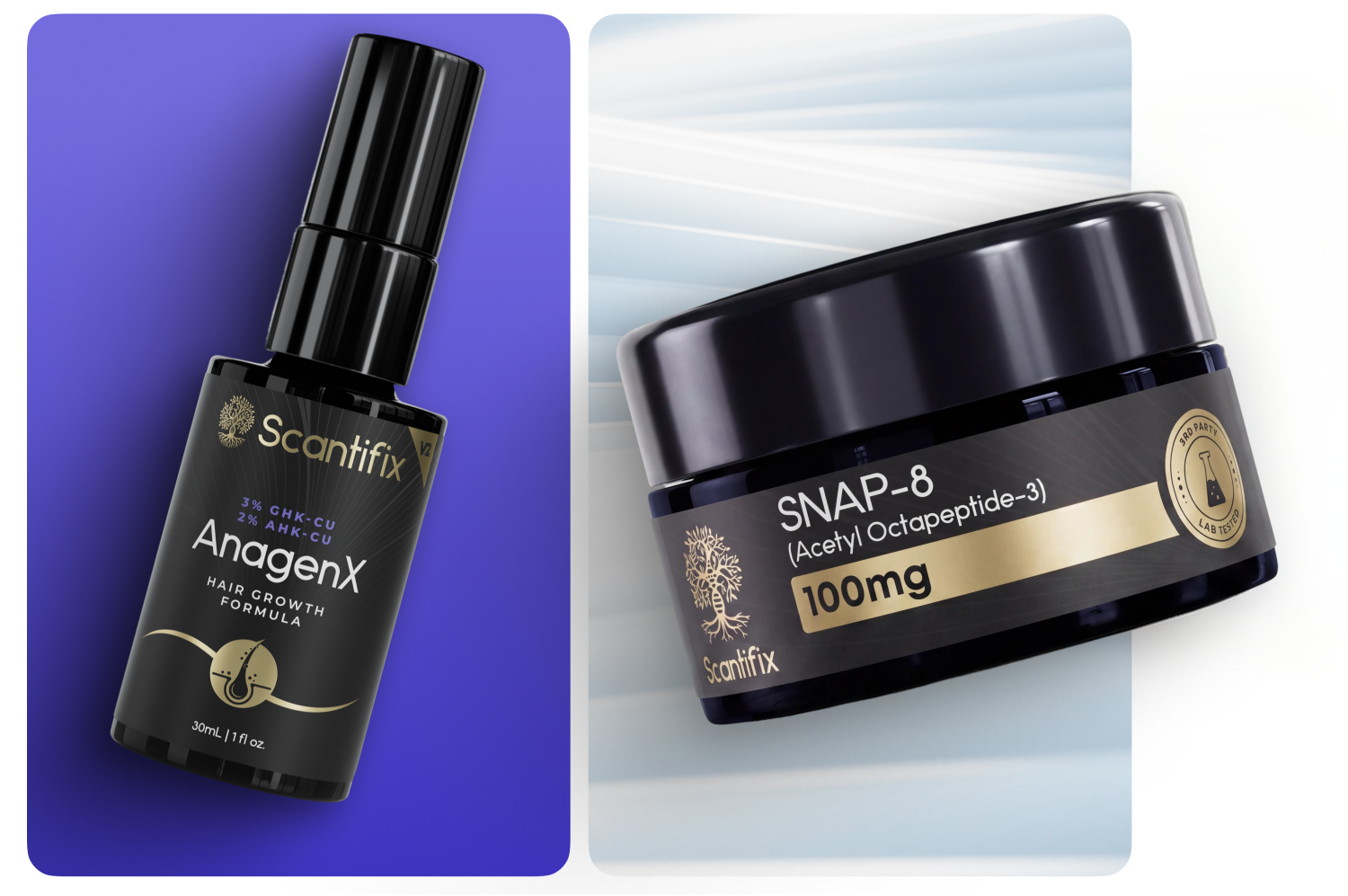
SNAP-8 peptide, or Acetyl Octapeptide-3, is structurally related to Argireline and is designed to influence the same signaling pathway involved in muscle contraction. It is commonly included in formulations for forehead lines, crow's feet, and other expression-related wrinkles. As with any topical peptide, its effectiveness depends on factors such as formulation quality, concentration, delivery, and consistent use.
Leuphasyl, or Pentapeptide-18, targets expression lines through a different signaling pathway than Argireline or SNAP-8, which is why these peptides are often combined in multi-peptide formulas. Rather than freezing facial muscles, they are intended to gradually soften the appearance of expression lines, with effects that are subtler than injectable treatments.
Best Peptides for Static Wrinkles
Static wrinkles call attention to a different part of skin aging: the gradual decline of the dermal framework that helps the skin resist creasing.
Signal peptides are short amino-acid sequences designed to communicate with skin cells. Some mimic fragments created when structural proteins are naturally broken down. These fragments can act as messages suggesting that repair is needed.
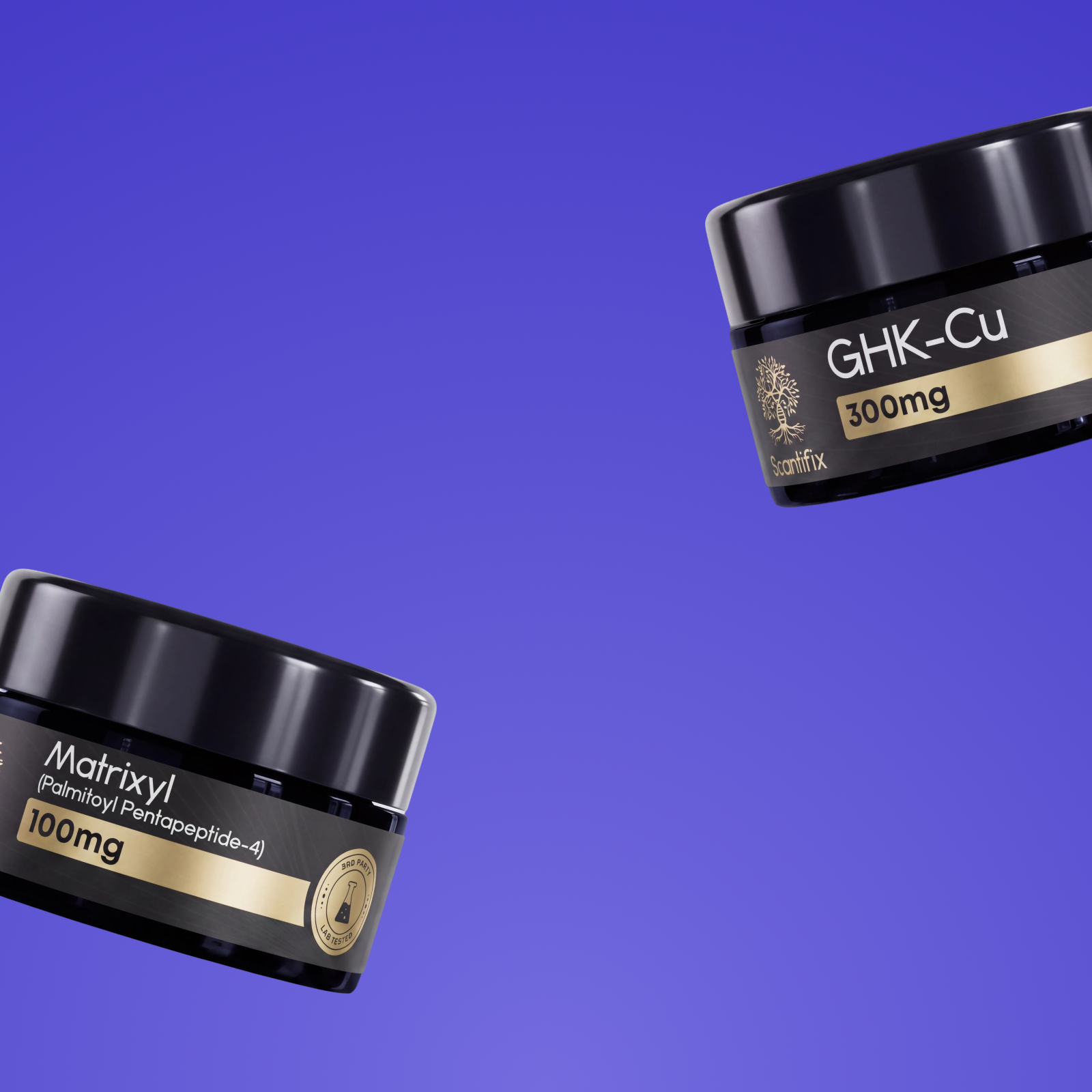
Matrixyl commonly refers to Palmitoyl Pentapeptide-4, a signal peptide derived from a sequence found in collagen.
Research suggests that it can encourage fibroblasts to support the production of extracellular matrix components, including collagen. Clinical evidence is not equally strong for every Matrixyl-containing formulation, but it remains one of the better-known cosmetic signal peptides discussed in anti-aging research (Schagen, 2017).
Syn-Coll, or Palmitoyl Tripeptide-5, is designed to support collagen-related signaling through pathways associated with transforming growth factor beta.
Supplier and laboratory research also suggests that it may help reduce the activity of enzymes involved in collagen degradation. However, much of the ingredient-specific evidence is proprietary, so its benefits should not be presented as conclusively established across all products and concentrations.
GHK-Cu is a naturally occurring copper-binding peptide associated with tissue remodeling and repair. Laboratory research suggests that it can influence genes and cellular pathways involved in collagen production, antioxidant defense, inflammation, and wound healing (Pickart & Margolina, 2018).
Supporting Both Types of Wrinkles with Scantifix
Scantifix offers different ways to explore this multi-pathway approach, depending on whether you prefer a customized serum or a professionally finished formula.
Wrinkler Twinkler is a customizable topical system that combines SNAP-8, Serpen-Syl, and GHK-Cu.
Each peptide has a different role within the routine. SNAP-8 is intended to address the appearance of expression-related lines, while GHK-Cu supports broader repair and structural processes. Serpen-Syl offers another complementary approach to visible skin smoothing.
Because the ingredients are supplied for custom preparation, Wrinkler Twinkler may appeal to users who enjoy mixing their own topical peptide serum and adjusting their routine.
For a broader, ready-to-use approach, Agelixir combines multiple peptides in one professionally formulated serum. Its peptide complex is designed to support more than one aspect of visible aging, including expression lines, collagen-related structure, skin renewal, and hydration.
This makes Agelixir particularly relevant when wrinkles no longer fit neatly into one category. A forehead, for example, may show lines during movement as well as deeper creases that remain visible at rest.
Agelixir also removes the need to reconstitute or combine individual peptides. The formula is balanced, preserved, and ready for consistent daily use. In a 12-week clinical study of the finished product, participants experienced a 23% reduction in visible wrinkle count.
That result applies to Agelixir as a complete formulation, rather than proving the effect of any single peptide within it.
Final thoughts
Dynamic and static wrinkles are not competing diagnoses, and the face does not age in tidy categories.
A line may begin with movement, deepen as collagen declines, and become more visible when the skin is dry or sun-damaged. It may also be affected by changes in facial volume and the structures beneath the skin.
Recognizing these overlapping causes changes the question from “What removes wrinkles?” to “What is contributing to this particular wrinkle?”
That shift matters. It encourages a more thoughtful approach built around expression signaling, structural support, hydration, protection, and consistent care.
Not every line requires the same strategy. But once you understand how a wrinkle behaves, you can begin to understand what your skin may need.
References
Blanes-Mira, C., et al. (2002). A synthetic hexapeptide (Argireline) with antiwrinkle activity. International Journal of Cosmetic Science, 24(5), 303–310. https://pubmed.ncbi.nlm.nih.gov/18498523/
Hillebrand, G. G., et al. (2010). New wrinkles on wrinkling: An 8-year longitudinal study on the progression of expression lines into persistent wrinkles. British Journal of Dermatology, 162(6), 1233–1241. https://pubmed.ncbi.nlm.nih.gov/20184587/
Pickart, L., & Margolina, A. (2018). Regenerative and protective actions of the GHK-Cu peptide in the light of the new gene data. International Journal of Molecular Sciences, 19(7), 1987. https://doi.org/10.3390/ijms19071987
Schagen, S. K. (2017). Topical peptide treatments with effective anti-aging results. Cosmetics, 4(2), 16. https://doi.org/10.3390/cosmetics4020016
Shin, J. W., et al. (2019). Molecular mechanisms of dermal aging and antiaging approaches. International Journal of Molecular Sciences, 20(9), 2126. https://doi.org/10.3390/ijms20092126
Swift, A., Liew, S., Weinkle, S., Garcia, J. K., & Silberberg, M. B. (2021). The facial aging process from the “inside out.” Aesthetic Surgery Journal, 41(10), 1107–1119. https://doi.org/10.1093/asj/sjaa339
Wang, Y., Wang, M., Xiao, X. S., Huo, J., & Zhang, W. D. (2013). The anti-wrinkle efficacy of Argireline, a synthetic hexapeptide, in Chinese subjects: A randomized, placebo-controlled study. American Journal of Clinical Dermatology, 14(2), 147–153. https://pubmed.ncbi.nlm.nih.gov/23417317/



Leave a comment
All comments are moderated before being published.
This site is protected by hCaptcha and the hCaptcha Privacy Policy and Terms of Service apply.