


If you’ve spent any time looking into anti-aging skincare, you’ve probably come across both peptides and retinol. They tend to show up in the same conversations about fine lines, collagen, and skin quality, but rarely with a clear explanation of how they actually compare.
It can start to feel like you’re supposed to pick one. But when you break it down, they’re not even solving the same problem in the same way. In fact, you probably don't need to choose one over the other.
Let's explore how the two compare so you can make an informed decision about your routine.
What are retinoids?
Retinoids are vitamin A derivatives. Retinol is the most common over-the-counter form, with prescription options like tretinoin available through a dermatologist. They've been a mainstay in skincare for a good reason. The effects have been studied for decades and are well-documented.
Once active in the skin, they influence how cells behave in a few key ways. Skin cell turnover speeds up, bringing fresher cells to the surface faster. Collagen production increases and its breakdown is reduced in the deeper layers (Fisher et al., 1996; Griffiths et al., 1993). Pigment distributes more evenly. Over time, the benefits are smoother texture, softer fine lines, and more even tone. For sun damage in particular, retinoids have a strong track record (Griffiths et al., 1993).
Where people run into difficulty is tolerability. Because retinoids actively push the skin to renew faster, they can temporarily disrupt the skin barrier, especially early on. Dryness, irritation, and sensitivity are common during the adjustment period, and the skin becomes more vulnerable to sun exposure in the process, making daily SPF essential.
What are peptides?
Peptides are short chains of amino acids that act as signaling molecules in the skin. Rather than pushing the skin to renew faster, they work by communicating with cells to support specific biological processes.
Different peptides send different signals. Signal peptides prompt the skin to produce more collagen and elastin, supporting firmness and reducing the appearance of fine lines (Robinson et al., 2005). Copper peptides support tissue repair and remodeling, helping skin recover and maintain its structural integrity (Pickart & Margolina, 2018). Neuromodulatory peptides address the muscle contractions that deepen expression lines over time, softening their appearance without affecting movement dramatically (Blanes-Mira et al., 2002).
The visible results tend to be gradual but meaningful, supporting firmer skin, improved texture, and a more resilient barrier. They're also generally well-tolerated. Peptides are not typically associated with the same level of irritation or photosensitivity as retinoids, making them a good option for sensitive skin and a reliable everyday ingredient for most skin types.
Do they compete or work together?
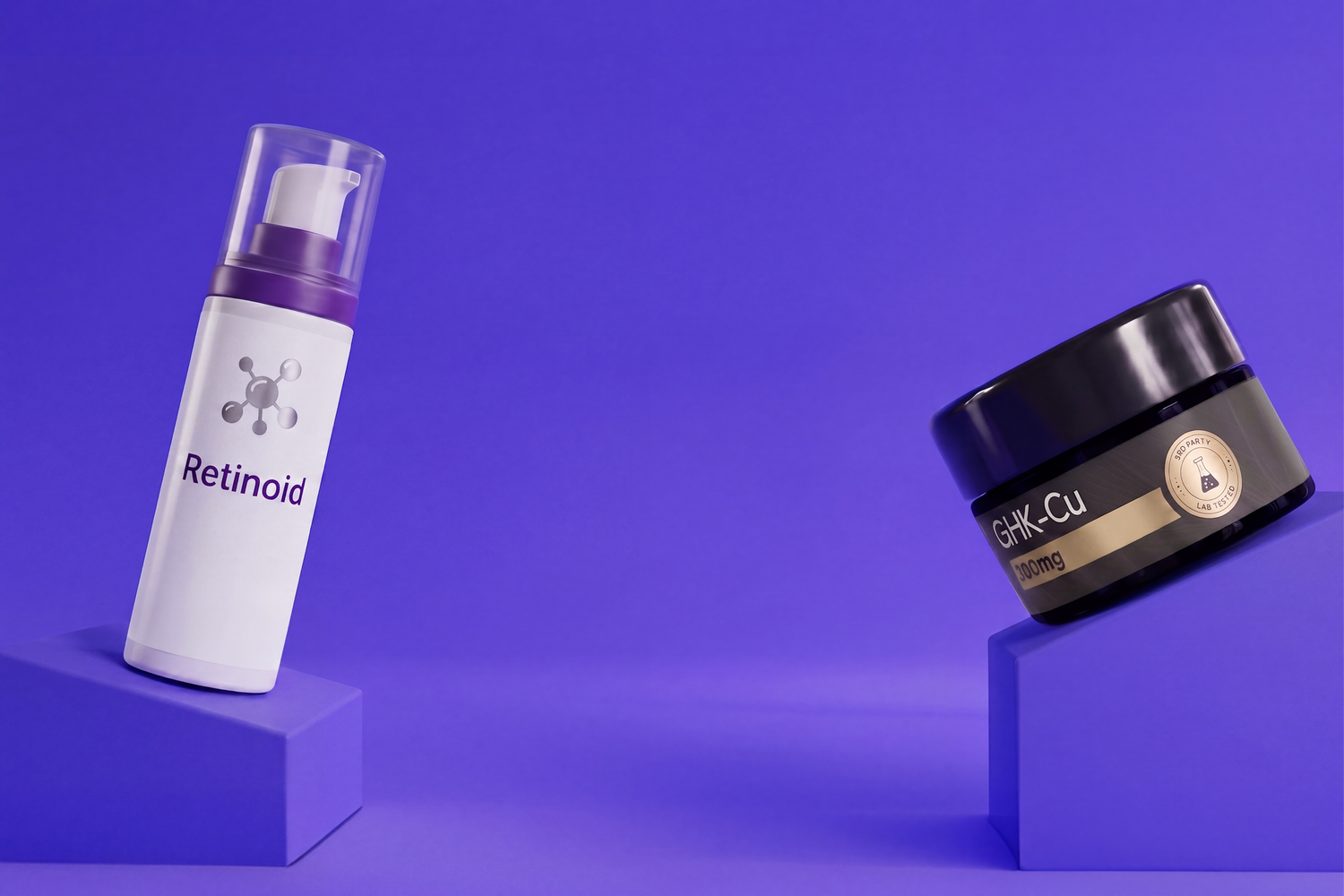
Can you use peptides and retinol together? It’s a common question. Despite being frequently compared, peptides and retinoids don't do the same job. Retinoids push the skin to renew and rebuild from within. Peptides act as messengers, guiding repair and helping the skin maintain its structure through that process.
Those are complementary functions, not competing ones. The skin needs both acceleration and support to age well. Using one doesn't make the other redundant, and combining them doesn't create conflict.
That said, there are situations where you might choose one over the other. If your skin is sensitive or already irritated, adding a retinoid can intensify that sensitivity in the short term. Peptides are often considered a gentler option.
You should also consider that layering too many actives at once can overwhelm the skin barrier. The ingredients don’t cancel each other out, but the skin has limits in how much it can handle at one time. Starting with one and introducing the other gradually tends to work better than doing everything at once.
How to use both in your routine
Many people incorporate both without issue. It's more about how you approach it than whether you can.
Timing is important. Retinoids are best used in the evening, partly because the skin naturally shifts into repair mode overnight, and partly because they increase sun sensitivity. Peptides are flexible and can be used morning, evening, or both.
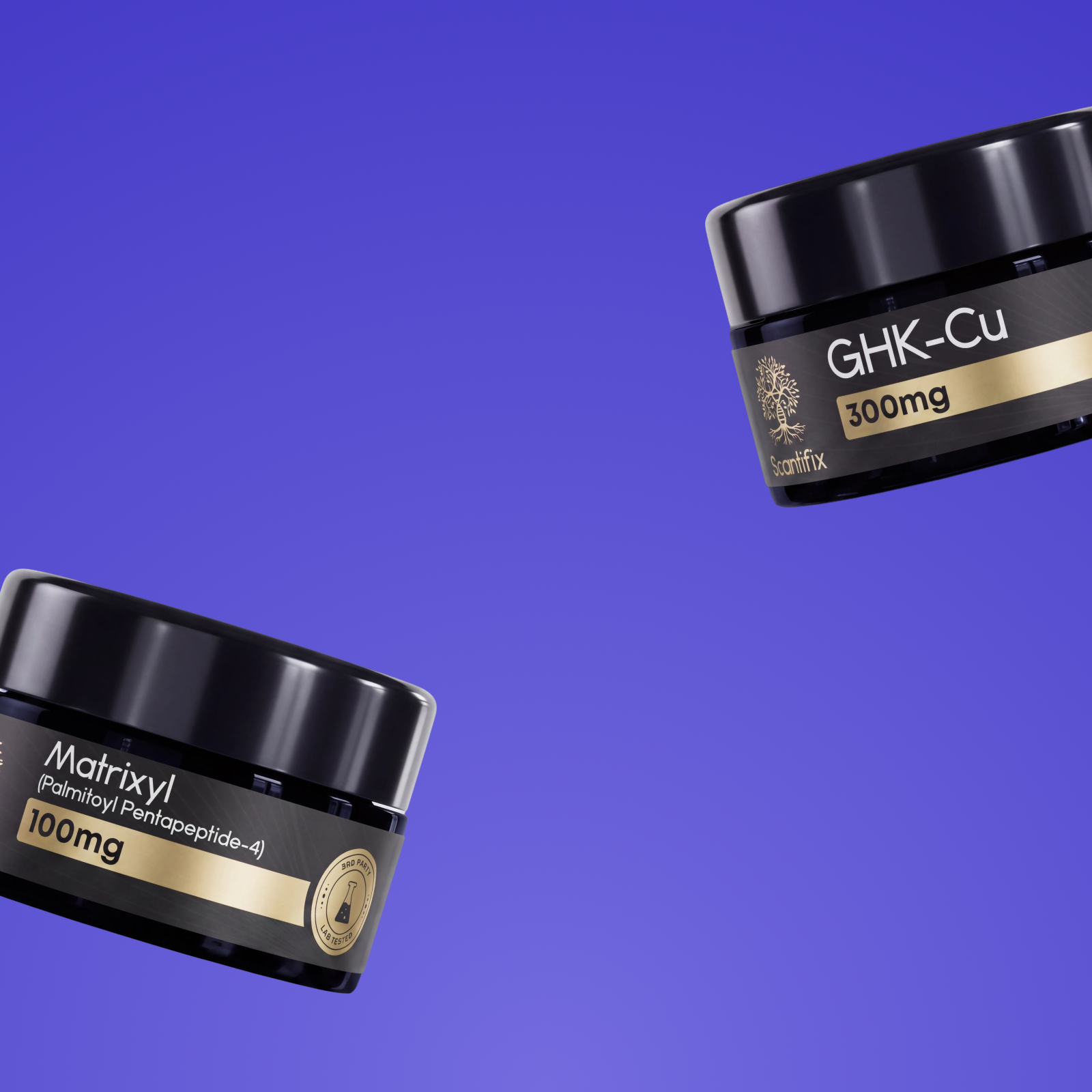
If you’re new to retinoids, you’ll want to start slowly. Building up gradually and paying close attention to how your skin responds before increasing frequency gives the barrier time to adapt. Peptides can play a supportive role here. Copper peptides like GHK-Cu and signal peptides like Matrixyl and Syn-Coll support skin repair processes and help maintain collagen signaling as the skin adjusts (Pickart & Margolina, 2018; Robinson et al., 2005).
Regardless of what your routine looks like, broad-spectrum mineral sunscreen is a must, especially when using retinoids. Daily sun protection is essential to prevent the increased sensitivity retinoids create from leading to additional UV damage that can offset their benefits.
For some people, peptides are simply the better fit. If retinoids are too difficult to tolerate, or if you prefer a gentler everyday approach, peptides are something most skin types can use consistently day to day.
Quality matters
Quality matters with any skincare ingredient, but with peptides it's especially important. Peptides are sensitive molecules and purity, formulation, and packaging all affect whether they remain active by the time they reach your skin.
Look for products with purity levels of 98% or higher, verified through third-party testing. Certificates of analysis should confirm both the peptide identity, purity, and concentration. Peptides can degrade when exposed to light and heat, so protective packaging like violet or amber glass preserves potency.
Aim for clean ingredient lists without unnecessary fillers or additives. You might also consider opting for raw peptides to create your own DIY serums. This gives you more control over your skincare formula and eliminates uncertainty. You know exactly what you’re getting: high-purity peptides and a clean base that you’ve chosen yourself.
The bottom line
Peptides and retinoids are not competing strategies. They work through different mechanisms and address different aspects of skin aging, which is exactly what makes them useful together. Retinoids drive renewal and structural change from within. Peptides support how the skin responds, repairs, and maintains itself through that process. And though they can be used together, it might not be the right fit for everyone. With that understanding, you're in a much better position to build a routine that actually works for your skin and your goals.
 References
Blanes-Mira, C., Clemente, J., Jodas, G., Gil, A., Fernández-Ballester, G., Ponsati, B., Gutierrez, L., Pérez-Payá, E., & Ferrer-Montiel, A. (2002). A synthetic hexapeptide (Argireline) with antiwrinkle activity. International journal of cosmetic science, 24(5), 303–310. https://doi.org/10.1046/j.1467-2494.2002.00153.x
Fisher, G. J., Datta, S. C., Talwar, H. S., Wang, Z. Q., Varani, J., Kang, S., & Voorhees, J. J. (1996). Molecular basis of sun-induced premature skin ageing and retinoid antagonism. Nature, 379(6563), 335–339. https://pubmed.ncbi.nlm.nih.gov/8552187/
Griffiths, C. E. M., Russman, A. N., Majmudar, G., Singer, R. S., Hamilton, T. A., & Voorhees, J. J. (1993). Restoration of collagen formation in photodamaged human skin by tretinoin (retinoic acid). The New England Journal of Medicine, 329(8), 530–535. https://pubmed.ncbi.nlm.nih.gov/8336752/
Pickart, L., & Margolina, A. (2018). Regenerative and Protective Actions of the GHK-Cu Peptide in the Light of the New Gene Data. International journal of molecular sciences, 19(7), 1987. https://doi.org/10.3390/ijms19071987
Robinson, L. R., Fitzgerald, N. C., Doughty, D. G., Dawes, N. C., Berge, C. A., & Bissett, D. L. (2005). Topical palmitoyl pentapeptide provides improvement in photoaged human facial skin. International journal of cosmetic science, 27(3), 155–160. https://doi.org/10.1111/j.1467-2494.2005.00261.x


Leave a comment
All comments are moderated before being published.
This site is protected by hCaptcha and the hCaptcha Privacy Policy and Terms of Service apply.